
Why In Vitro Biochemical Testing Matters
While physical characterisation confirms that a liposome has been correctly synthesised, in vitro biochemical testing demonstrates how it will behave in the human body. By mimicking real physiological environments, these tests evaluate the formulation’s true efficacy, protective strength, and digestive survival. This crucial layer of validation provides the exact guidelines needed to confirm if a product is optimised and ready for further cellular and in vivo studies.
Stability Testing
-
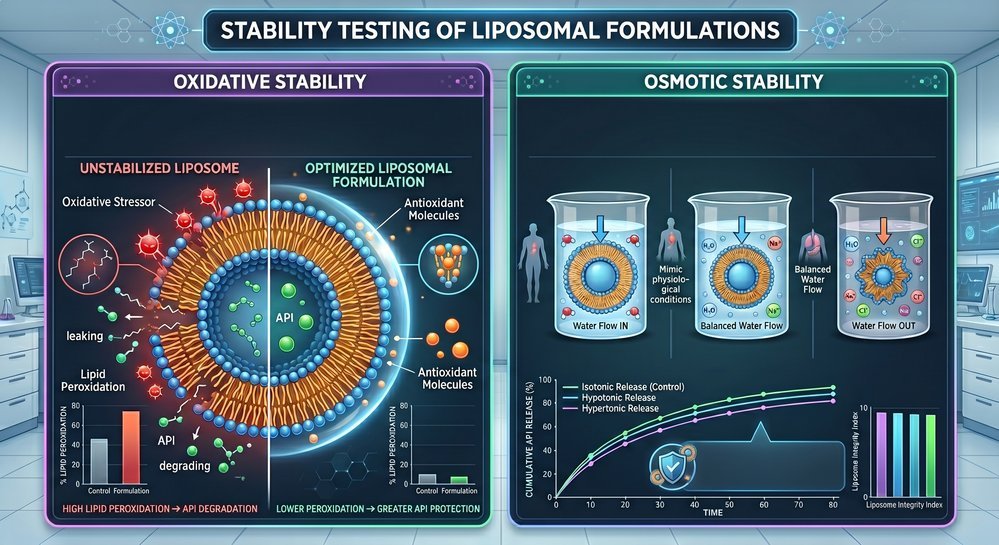
Oxidative Stability
Liposomal formulations, when exposed to oxidative stress, exhibit lower lipid peroxidation, indicating greater protection of the API against oxidative degradation.
-
Osmotic Stability
Determines the stability of a liposomal system in solutions of different salt concentrations (hypotonic, isotonic and hypertonic). Consistent release patterns with slight deviation confirm superior liposomal integrity.
In Vitro Release Study
-
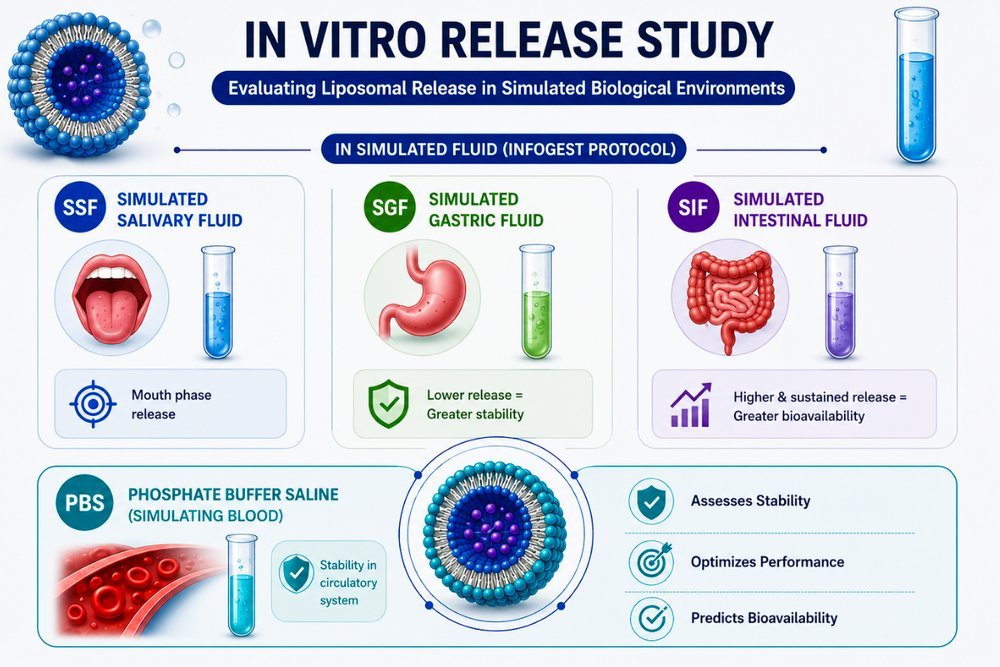
In simulated Fluid
Liposomal formulations are assessed using the INFOGEST protocol on in vitro digestion using simulated fluids
- SSF (Simulated Salivary Fluid): To study the release pattern in the mouth phase. Important for understanding the release pattern of sublingual formulations.
- SGF (Simulated Gastric Fluid): To study the release pattern in the gastric environment. A lower release indicates greater stability of the liposomal formulation.
- SIF (simulated Intestinal Fluid): To study the release pattern in intestinal fluid. Higher and sustained release of API indicates greater bioavailability over a prolonged period
Product Specific Study
-
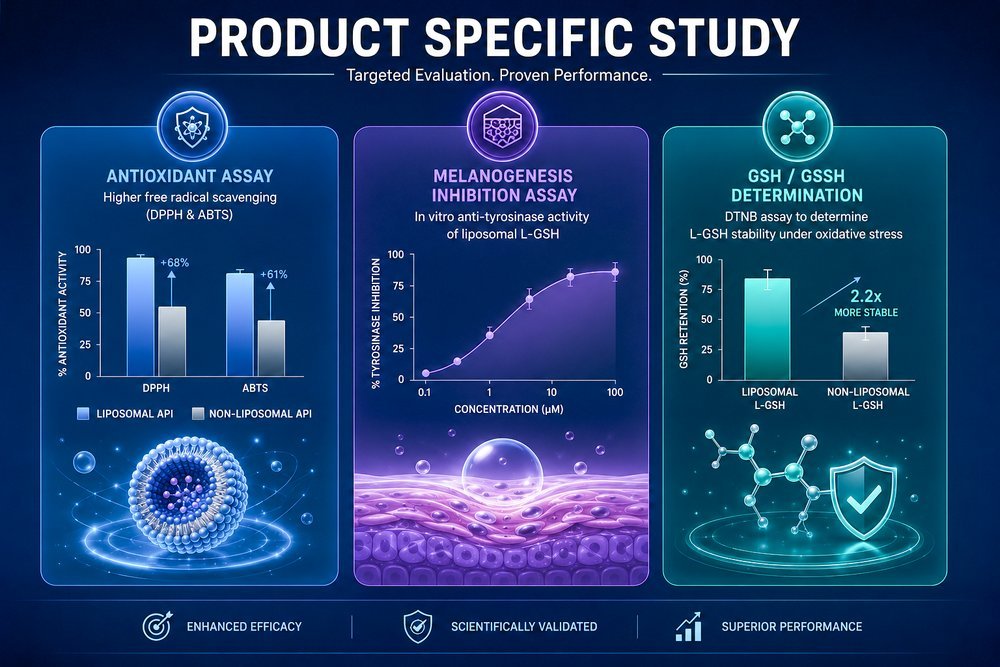
Antioxidant Assay
Liposomal APIs such as vitamin C & α-lipoic acid confirm free radical scavenging activity of liposome compared to non-liposomal APIs, indicating improved antioxidant capacity.
-
Melanogenesis Inhibition Assay
In vitro enzymatic assay to determine the anti-tyrosinase activity of liposomal L-GSH.
-
GSH/GSSH determination
In vitro enzymatic assay using DTNB to determine the stability of L-GSH when exposed to oxidative stress
-
Franz Diffusion Assay
In vitro membrane permeation study to evaluate the transdermal or transmucosal penetration efficiency of liposomal APIs, compared to non-liposomal forms.
Product-Specific Documentation We Provide
Evaluate stability under oxidative stress and measure structural integrity across diverse osmotic environments to guarantee robust API protection prior to biological entry.
Track precise API release kinetics across simulated fluids (salivary, gastric, and intestinal to validate digestive survival.
Quantify formulation-specific therapeutic potency through targeted functional bioassays and Franz diffusion membrane permeation studies.
Method Validation & Assay Precision Troubleshooting
Evaluation of ingredient release and absorption potential under simulated gastrointestinal conditions to predict in vivo performance.
Determine the stability and efficiency of liposomal and encapsulated actives under physiological and storage-relevant conditions.
Assessing and interpretation of site-specific release behavior and protection of active ingredients through gastric and intestinal environments.
Generate scientific evidence to compare formulations, optimize compositions, and substantiate product claims.
Product Testing & Validation Workflow
Evaluate formulation structural integrity against oxidative degradation and osmotic stress variations to ensure baseline protection.
Map active ingredient release kinetics across simulated digestive stages (mouth, stomach, intestine)
Designing customised experimental models and selecting specific assays tailored to the product’s delivery route, formulation characteristics, and target claims.
Aggregate all physical, chemical, stability, and release data into a comprehensive technical file for regulatory submission and market approval.
Why Collaborate with Lipoedge
Integrated in vitro evaluation from method design to data interpretation, ensuring seamless alignment between formulation, characterization, and performance testing.
Advanced testing including release kinetics, product-specific in vitro assays, and stability profiling- all conducted under one roof.
Studies designed using established models to support regulatory submissions and product claims.
Tailored experimental design, protocol modifications, and comparative studies based on product type and target market.
Driven by highly qualified and experienced scientists, forming the core strength of the department, ensuring accuracy, innovation, and reliable outcomes.
How Can We Support
Your Goals?
Choose the path that fits your needs — from analytical testing to fully bespoke liposomal formulation design.
Elevate Your Formulation Testing
Validate exactly how your liposomal products behave inside the human body using advanced, bio-simulated physiological modelling.
- Verify Physiological Stability Profiles
- Map Simulated Fluid Release Kinetics
- Evaluate Product-Specific Bioassays
Resolve Complex Testing Challenges
Overcome complex biological delivery obstacles to guarantee your final consumer product achieves its targeted efficacy and performance claims.
- Optimise Kinetic Release Profiles
- Resolve Franz Diffusion Inconsistencies
- Standardise Custom Bioassay Protocols
Download Our Capabilities Brochure
Equip your development team with our comprehensive analytical roadmap for premium, scientifically verified liposomal products.
- Physiological Verification Blueprints
- End-to-End Testing Framework
- Our Specialised Assay Portfolio
The INFOGEST protocol provides a standardised, widely accepted framework that closely simulates gastrointestinal conditions. This ensures reproducible and comparable evaluation of liposomal release and bio-accessibility across formulations.
Bile salts and pancreatic enzymes disrupt phospholipid bilayers in the intestinal phase, enabling controlled release of encapsulated actives. This process allows precise quantification of the bioaccessible fraction.
Yes. We offer a comprehensive suite of product-specific assays to validate the formulation’s nutraceutical and cosmeceutical performance. Our scientific team regularly designs, adapts, and validates testing protocols tailored entirely to your unique active ingredient and target market claims.
Liposomal formulations are designed to remain stable in acidic gastric conditions, thereby protecting encapsulated actives. This stability supports targeted release in the intestinal phase, where absorption is highest.
While physical characterisation confirms that your liposomes are structured correctly, in vitro biochemical testing demonstrates how well your liposomes will perform in the human body.