

Lipoedge: Experts in Liposomes
Delivering highest quality liposomes & maintaining steadfast commitment to research excellence.
Primary bilayer-forming lipid responsible for vesicle architecture.
Supports membrane flexibility and dynamic behaviour.
Aids membrane organisation and structural integrity.
Improves lipid packing stability within the bilayer.
Uniform vesicles and optimal encapsulation across batches.
Structural stability maintained consistently over time.
Maintains the integrity and potency of the actives.
Consistent and reliable quality in every manufactured batch.
Natural Sources of Lecithin

Sunflower Lecithin
Non-GMO, allergen-free profile with excellent nutraceutical scalability and regulatory comfort.
Preferred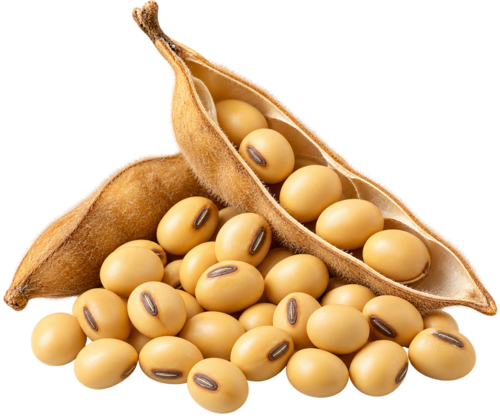
Soya Lecithin
High PC content but associated with GMO perceptions and allergen labelling requirements.
Use with Caution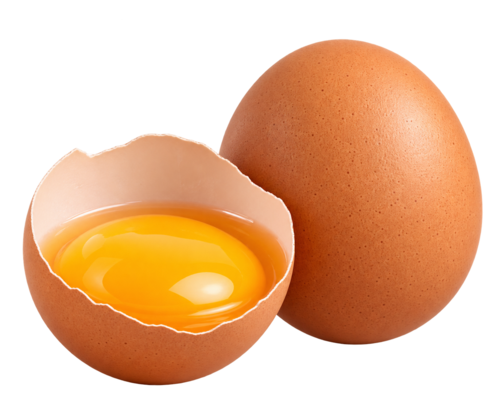
Egg Lecithin
Highest PC content naturally, but animal origin and egg-allergen status limit nutraceutical use.
Limited UsePhospholipid Profile
Composition ranges across the three major lecithin sources used in pharmaceutical and cosmeceutical liposomal formulations.
| Phospholipid | Sunflower | Soybean | Egg Yolk |
|---|---|---|---|
| Phosphatidylcholine (PC) | 20 – 26% | 20 – 22% | 70 – 80% |
| Phosphatidylethanolamine (PE) | 4 – 10% | 16 – 22% | 10 – 17% |
| Phosphatidylinositol (PI) | 15 – 19% | 13 – 16% | – |
| Phosphatidic Acid (PA) | 2 – 5% | 5 – 10% | – |
| Phosphatidylserine (PS) | < 1% | ~ 1% | < 1% |
| LPC | < 3% | < 3% | 2% |
Factors for Choosing Lecithin
| Factor | Sunflower | Soya | Egg |
|---|---|---|---|
| Plant-based suitability | Yes | Yes | No |
| Allergen perception | Lower | Higher — FALCPA / EU Annex II | Higher — FALCPA / EU Annex II |
| Clean-label positioning | Strong; Non-GMO | Sensitive; ~94% US Soya is GE | Limited (animal origin) |
| Global nutraceutical scalability | Excellent | Good (with label caveats) | Limited |
Why Sunflower Lecithin
Sunflower lecithin is widely preferred for modern nutraceutical liposomes because it balances performance, regulatory comfort, and consumer acceptance. Its non-GMO and allergen-free profile simplifies global compliance without sacrificing lipid quality.
Why Not Soya or Egg Lecithin?
Soya lecithin: Widely used but associated with allergen labelling requirements and GMO-related perceptions in specific markets, limiting clean-label positioning.
Egg lecithin: Naturally rich in PC and effective for bilayer formation, but its animal origin and egg-allergen status restrict suitability for nutraceutical use.
Advantages of Sunflower Lecithin

Non-Allergen
Reduces allergen and labelling concerns, enabling broader market acceptance globally.

Non-GMO
Supports GMO-sensitive markets and aligns with clean, non-GMO product positioning.

Plant-based & Vegetarian
Compatible with global dietary, cultural, and vegan lifestyle preferences.

Globally Scalable
Sourced from widely cultivated sunflower oil crops with reliable supply chains.
Reliable Liposome Performance
Purified sunflower lecithin forms stable bilayers with consistent, predictable quality.
Purification of Lecithin
Liposomal excellence begins with phospholipid purity. Natural lecithin is a complex mixture of phospholipids, neutral lipids, and trace impurities. While suitable for general emulsification, raw lecithin is not optimal for high-performance liposomal systems.
Our liposomal technology focuses on purifying lecithin into high-purity phosphatidylcholine (PC) — the primary structural lipid responsible for stable liposome bilayer formation.
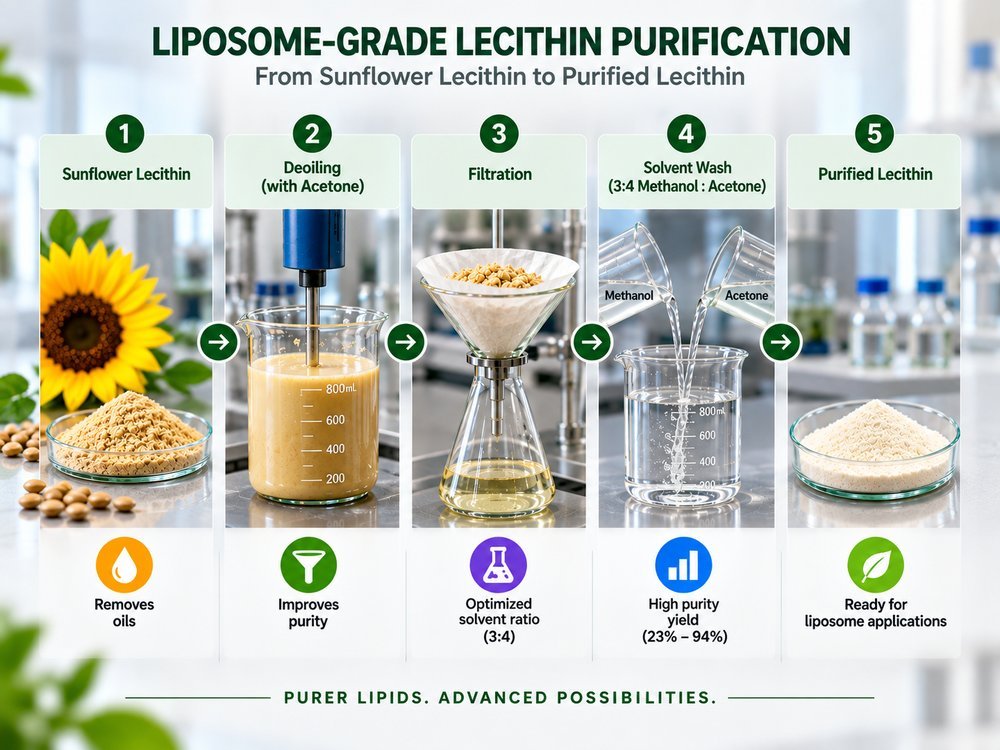
Why Our Technology Stands Out
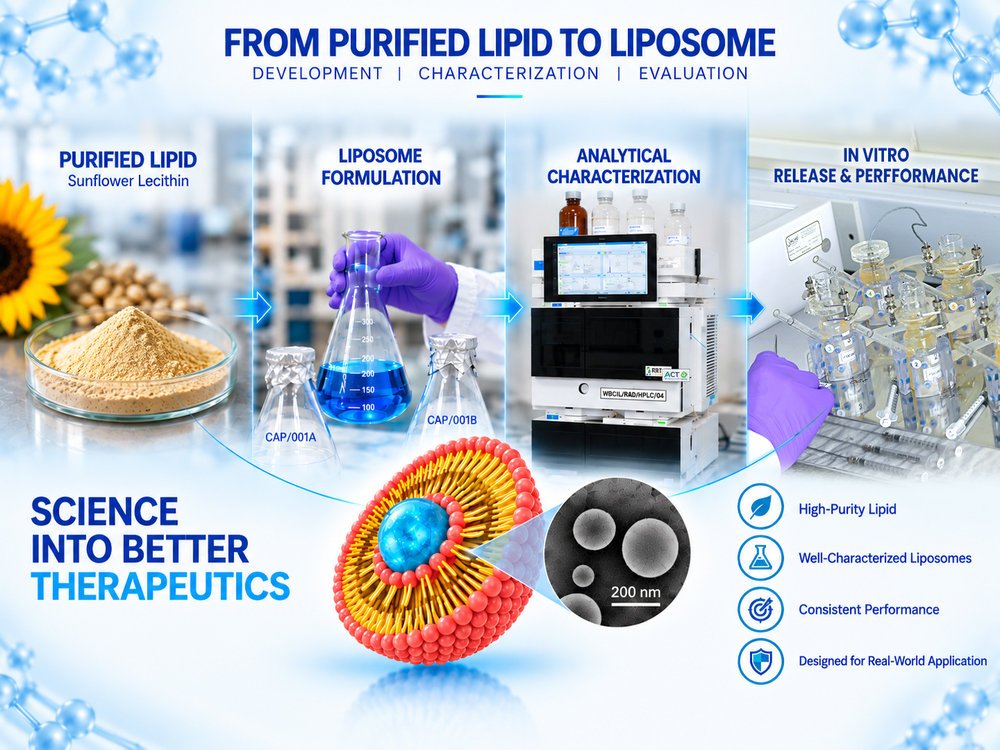
The level of purity ensures that liposomes formed using WBCIL phosphatidylcholine are more uniform, reproducible, and stable. This purified phosphatidylcholine is subsequently engineered into liposomes and evaluated through rigorous physicochemical, biological, and performance-based characterisation.
Quality and Compliance
Conduct internal inspections ensuring process control, content uniformity, and traceability in compliance with SOPs to maintain batch consistency and finished product quality.

Process Control
Monitor and control processes for consistent and reliable outcomes.

Content Uniformity
Ensure accurate and uniform content in every batch.

Batch Consistency
Maintain reproducibility and consistency across batches.

SOP Compliance
Follow and enforce Standard Operating Procedures.

Quality Traceability
Track and trace every step for complete transparency.

Internal Inspection
Conduct regular internal audits and inspections to ensure compliance.
Liposomal Characterizations
Comprehensive physicochemical testing protocols to Characterize Liposomes.
HPLC-based mapping of the phospholipid composition of liposomes. A high concentration of Phosphatidylcholine (PC) translates into higher product purity and greater shelf life.
Indicates uniformity in the size distribution of liposomes. High uniformity guarantees batch-to-batch clinical consistency. Acceptance criteria: ≤ 0.3
Nanoscale formulation allows for significantly increased cellular uptake. Acceptance criteria: < 300 nm
An indicator of the liposome’s surface charge. High Zeta Potential creates a strong repulsion between particles, preventing clumping and ensuring stability. Acceptance criteria: ≤ -30 mV
It acts like a “molecular fingerprint”. Every ingredient has a unique signal. FTIR confirms the chemical stability of the liposome.
A surface scan using EDAX examines the liposome’s surface and confirms its chemical composition. The presence of only the core components of a liposome- Nitrogen, Carbon, Oxygen, and Phosphorus verifies the purity of the liposomal preparation.
A microscopic-based examination that confirms spherical, smooth-surfaced nanoscale vesicle morphology of liposomes