
Why Physicochemical Characterisation Matters
The true efficacy of a liposome lies in its molecular architecture. To successfully boost bioavailability, a liposomal formulation must maintain robust structural integrity. Its physicochemical characterisation provides a scientific blueprint that proves a formulation has successfully transitioned from a simple physical mixture to an advanced, high-performance liposomal system. It ensures that liposomes meet three critical industry standards: optimal biological absorption, flawless batch-to-batch consistency, and maximum shelf life.
Physico Structure
-
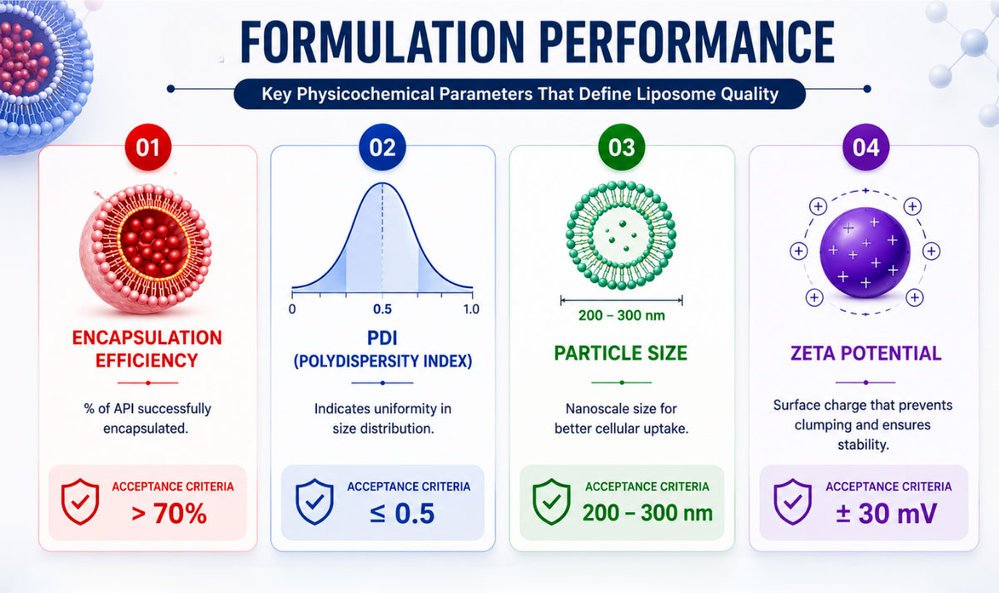
Assay & Encapsulation Efficiency
It is the percentage of API that is successfully encapsulated inside the liposome. Efficient encapsulation ensures improved bioavailability and therapeutic efficacy. Acceptance criteria >70%
-
PDI
Indicates uniformity in the size distribution of liposomes. High uniformity guarantees batch-to-batch clinical consistency. Acceptance criteria:<0.3
-
Particle Size
Nanoscale formulation allows for significantly increased cellular uptake. Acceptance criteria: <300 nm
-
Zeta Potential
An indicator of the liposome’s surface charge. High Zeta Potential creates a strong repulsion between particles, preventing clumping and ensuring stability. Acceptance criteria: <-30 mV
Chemico Structure
-
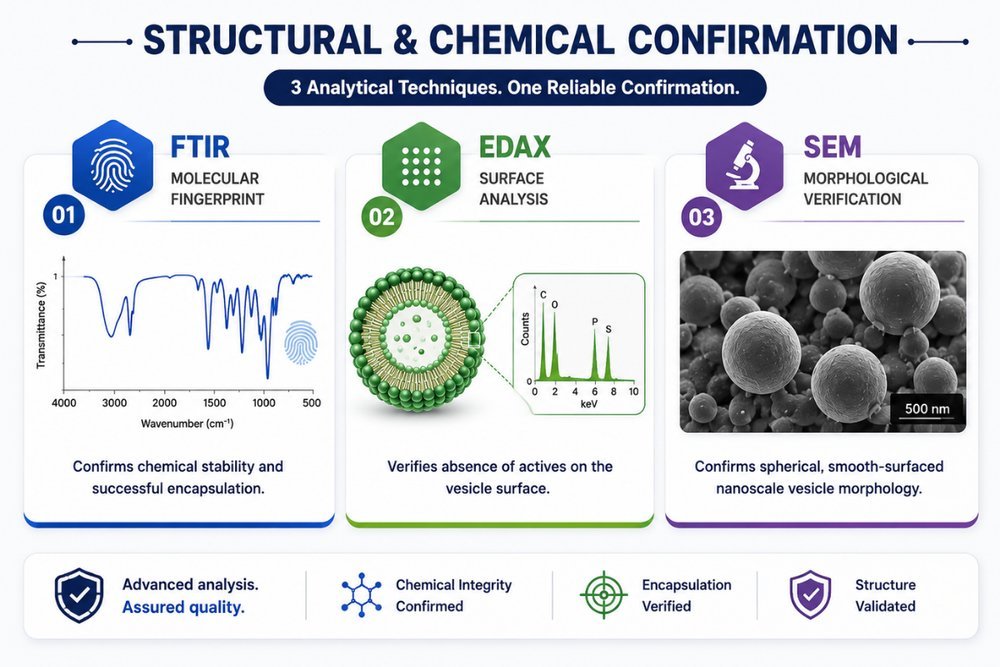
FTIR
It acts like a “molecular fingerprint”. Every ingredient has a unique signal. FTIR confirms chemical stability and successful encapsulation of active ingredients into a liposome.
-
EDAX
A surface scan using EDAX examines the particle’s surface. Surface scanning verifies the complete absence of actives at the vesicle surface, confirming successful encapsulation.
-
SEM/TEM
High-resolution microscopic imaging confirms the spherical, smooth, and unilamellar nanoscale morphology of the liposomes, validating the successful structural transformation of raw ingredients.
Thermal Stability & Integrity
-
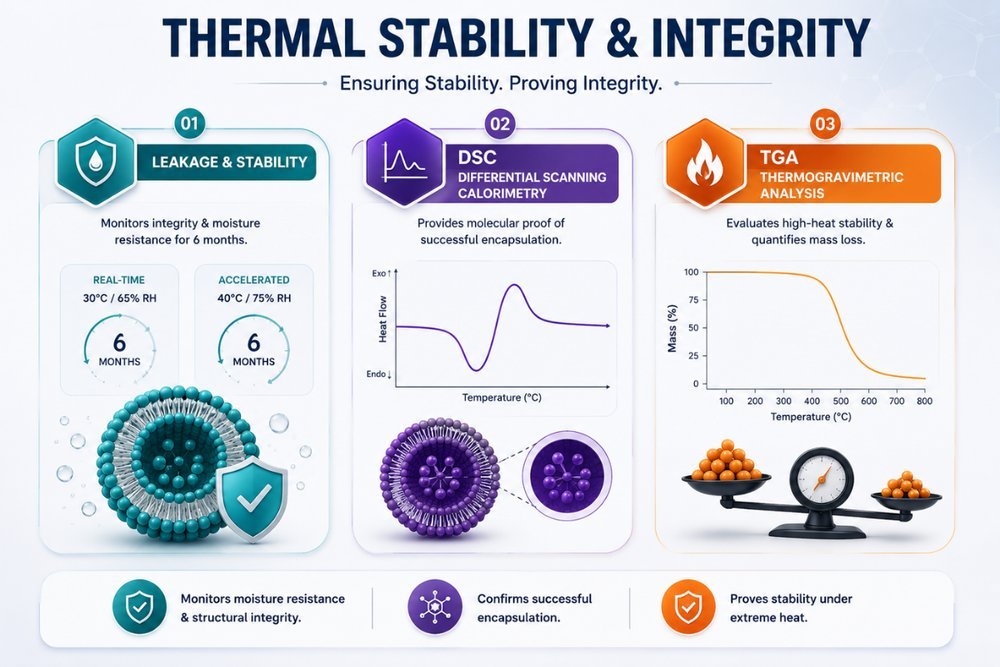
Leakage & Stability
Accelerated and real-time protocols monitor structural integrity and moisture resistance at 40°C/75% RH and 30°C/65% RH, respectively.
-
DSC
A thermal test that provides molecular proof that the active ingredient is successfully encapsulated inside the liposome rather than just being physically mixed.
-
TGA
A high-heat stability test that evaluates formulation resistance to severe thermal degradation. TGA quantifies mass loss under extreme heating.
Product-Specific Documentation Includes
Comprehensive lab reports combining advanced structural imaging (FTIR, EDAX, SEM) with critical performance metrics-including particle size, PDI, zeta potential, and encapsulation efficiency.
Comprehensive validation data charting formulation integrity over a 6–36-month period under both real-time (30°C / 65% RH) and accelerated (40°C / 75% RH) environmental conditions.
Technical documentation featuring DSC and TGA thermal analysis to prove successful liposomal encapsulation and robust heat resistance.
Liposomal Characterization Troubleshooting
Low zeta potential, particle clumping, unacceptable PDI variations resolved by optimizing surface charge.
High presence of active on vesicle surfaces, low encapsulation efficiency, resolved by modifying lipid-to-active ratio.
Non-spherical morphology/ rough surfaces of liposomes observed via SEM, resolved by adjusting the manufacturing process.
Physical mixing artefacts on DSC, rapid mass loss during high-heat, resolved by adjusting the manufacturing process and/ or lipid-to-active ratio.
Analytical Validation and Quality Documentation Framework
Testing particle size, PDI, surface charge, and encapsulation efficiency to verify baseline vesicle uniformity and stability.
Utilizing FTIR, EDAX, and SEM imaging to chemically and visually confirm successful active ingredient encapsulation over simple physical mixing.
Exposing batches to DSC/TGA thermal scans and 6-36 months stability chambers under accelerated and real-time conditions to monitor active leakage and product shelf life.
Consolidating performance certificates, stability data, and troubleshooting frameworks into a complete technical package to ensure flawless commercial manufacturing.
Why Collaborate with Lipoedge
High-precision tracking of particle size, PDI, and Zeta Potential using DLS guarantees batch uniformity and structural stability.
In-depth structural analysis using FTIR, EDAX, and high-resolution SEM imaging to chemically and visually confirm successful encapsulation over simple physical mixing.
Application of DSC and TGA thermodynamic analysis alongside 6-month accelerated and real-time stability protocols guarantees robust product shelf life and resistance to leakage under extreme environmental conditions.
Rigorous verification testing to ensure encapsulation efficiency consistently ≥ 70%, proving that the active ingredients are protected within the lipid bilayer for enhanced bioavailability.
How Can We Support
Your Goals?
Choose the path that fits your needs — from analytical testing to fully bespoke liposomal formulation design.
Elevate Your Formulation Testing
Validate your liposomal structure with our rigorous, multi-tiered analytical validation and quality documentation framework.
- Advanced Nanoparticle Physical Screening
- Definitive Molecular & Visual Proof
- Thermal & Shelf-Life Profiling
Customize Your Liposomal Formulation
Transform your raw active ingredients into high-performance, stable liposomal systems engineered to bypass common structural bottlenecks.
- Resolve Particle Agglomeration
- Maximize Core Encapsulation
- Upgrade Structural Thermal Resilience
Download Our Capabilities Brochure
Get our comprehensive technical brochure that covers all analytical services, formulation capabilities, and regulatory support in a single document.
- Comprehensive Quality Reporting
- End-to-End Analytical Framework
- Technical specifications & Troubleshooting
PDI below 0.30 indicates a monodisperse vesicle population, directly supporting consistent absorption rates, predictable release kinetics, and reliable dose delivery per batch. A high PDI indicates chaotic size distribution, which triggers particle clumping, rapid active leakage, and unpredictable clearance by the body.
Zeta potential measures surface charge, generating repulsive forces that prevent aggregation and sedimentation and serves as a leading indicator of long-term colloidal stability.
Encapsulation converts crystalline actives into an amorphous state, as confirmed by the absence of a DSC melting peak, thereby enhancing the solubility, dissolution rate, and bioavailability of the formulation.
Physicochemical characterization provides the scientific blueprint proving the formulation has achieved the molecular architecture needed for optimal biological absorption, batch consistency, and maximum shelf life.
PDI below 0.25 indicates a monodisperse vesicle population, directly supporting consistent absorption rates, predictable release kinetics, and reliable dose delivery per batch.
Yes. Particle size, PDI, zeta potential, EE%, and stability data form the core CMC documentation for FDA, EMA, CDSCO, and TGA submissions, validated per ICH Q2(R1).
We perform FTIR and DSC testing to provide unique molecular and thermal fingerprints that prove that the active is encapsulated within the liposome rather than just physically mixed. This is validated by EDAX surface scanning alongside high-resolution SEM/TEM imaging.