
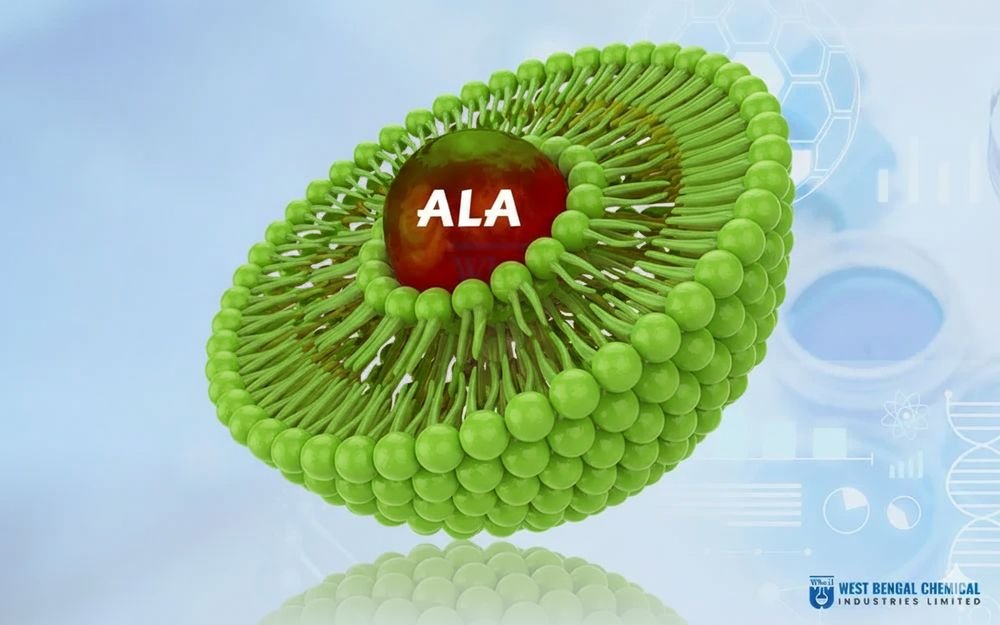
Liposomal Alpha Lipoic Acid
Free Alpha Lipoic Acid is severely limited by poor aqueous solubility, thermal sensitivity, and rapid hepatic first-pass metabolism. Standard oral ALA yields low, inconsistent plasma concentrations and a half-life too short for sustained therapeutic action. Lipoedge resolves this by encapsulating ALA within a pharmaceutical-grade phospholipid bilayer that shields it from thermal and acidic degradation. The result is a water-dispersible, stable, sustained-release ALA with confirmed superior intracellular delivery to mitochondria and cellular targets.
- Nano-liposomal particle size: Mean vesicle size of ~140.4 nm, confirmed by DLS, optimised for superior intestinal membrane interaction and cellular uptake efficiency.
- pH-resilient colloidal stability: Zeta potential of –54.99 mV delivers strong electrostatic repulsion, preventing vesicle aggregation across acidic gastric and intestinal pH conditions.
- Controlled particle distribution: PDI of ~0.22 confirms a tightly uniform liposome population, ensuring consistent absorption kinetics and reproducible formulation performance across batches.
- High ALA entrapment: Encapsulation efficiency of 85.39% locks ALA within the bilayer, protecting the heat-sensitive and acid-labile molecule from degradation throughout GI transit.
- Simulated gastrointestinal stability: The phospholipid bilayer shields ALA from acidic gastric degradation, where free ALA undergoes rapid thermal and hydrolytic breakdown at physiological temperatures.
- ALA release profile: Intestinal fluid triggers controlled sustained release, extending the therapeutic window beyond what is achievable with free ALA’s characteristically short plasma half-life.
- Cellular uptake (Caco-2 model): Liposomal membrane fusion enables direct intracellular ALA delivery, bypassing the transporter-limited absorption that restricts free ALA at higher therapeutic doses.
- Mitochondrial delivery validation: Liposomal encapsulation directs ALA to the mitochondrial matrix, where it functions as an essential cofactor in the pyruvate dehydrogenase complex and ATP synthesis pathways.
- Antioxidant regeneration activity: Intracellular ALA delivery provides sufficient cytosolic concentrations to simultaneously regenerate Vitamin C, Vitamin E, and glutathione from their oxidised forms.
- First-pass metabolism reduction: The liposomal matrix significantly slows hepatic first-pass clearance, resulting in a sustained plasma ALA concentration profile that is superior to that of free ALA solid dosage forms.
Liposomal Alpha Lipoic Acid is available in a wide range of dosage formats suitable for both pharmaceutical and nutraceutical applications, offering flexibility for custom formulations.



| Attribute | Traditional ALA | Liposomal ALA |
|---|---|---|
| Aqueous Solubility | Poorly water-soluble; incompatible with liquid formats | Water-dispersible colloidal suspension; no harsh solvents required |
| Thermal Stability | Highly heat-sensitive; degrades during processing and storage | Protected within a bilayer; DSC confirms suppressed melting point |
| GI Stability | Acid-labile; degrades rapidly in the gastric environment | Shielded from acidic and enzymatic degradation through GI transit |
| First-Pass Metabolism | Extensive hepatic clearance; short, inconsistent plasma half-life | Sustained plasma presence via controlled liposomal release kinetics |
| Intracellular Delivery | Limited by absorption ceiling and rapid systemic clearance | Membrane fusion delivers ALA directly to cytosol and mitochondria |
| Target Segment | Basic wellness, commodity antioxidant formats | Pharma-grade neuropathy, metabolic, and premium longevity applications |
- Solves aqueous incompatibility: Liposomal encapsulation converts fat-soluble ALA into a fully water-dispersible form, eliminating the need for synthetic emulsifiers or harsh organic solvents.
- Bypasses rapid hepatic clearance: The liposomal matrix substantially slows first-pass metabolism, delivering a sustained therapeutic plasma window that free oral ALA cannot achieve.
- Thermal and acidic shielding: The phospholipid bilayer protects heat-sensitive and acid-labile ALA from degradation during both manufacturing processing and gastric transit conditions.
- Direct mitochondrial delivery: Liposomes fuse with cell membranes to deposit ALA into the cytosol, enabling its function as a mitochondrial cofactor for ATP production and free radical scavenging.
- Universal antioxidant regeneration: Intracellular ALA concentrations achieved via liposomal delivery are sufficient to simultaneously regenerate Vitamin C, Vitamin E, and glutathione from their oxidised states.
- R-ALA customisation available: The naturally occurring R-enantiomer, with superior pharmacokinetic properties, can be encapsulated for premium neurological and metabolic support formulations that require biological specificity.
| Key Quality Parameter | Formulation Advantage |
|---|---|
| Encapsulation Efficiency (85.39%) | Protects heat-sensitive ALA payload from thermal and moisture degradation throughout shelf life |
| Superior Morphology | SEM confirms smooth spherical vesicles transformed from irregular ALA API crystals |
| Dithiol Ring Integrity (FTIR-Verified) | C=O and –OH stretching confirms stable hydrogen bonding; antioxidant potency fully preserved |
| Stability (40°C/75% RH) | Assay declines only from ~32.14% to ~31.85% over six months of accelerated testing |
| Low Moisture (LOD ~2.10%) | Non-hygroscopic powder matrix maintained well within the 5.0% specification limit |
Lipoedge Liposomal ALA addresses applications where free ALA’s instability and rapid clearance have historically prevented therapeutic plasma and intracellular concentrations from being sustained.
- Diabetic neuropathy: Sustained plasma ALA levels achievable via liposomal delivery support nerve pain management and nerve function restoration in diabetic peripheral neuropathy formulation protocols.
- Metabolic syndrome and insulin resistance: Liposomal ALA delivers the intracellular concentrations required to enhance GLUT4 translocation, improve glucose uptake, and modulate insulin receptor signalling pathways.
- Heavy metal chelation: ALA’s unique capacity to cross the blood-brain barrier and chelate intracellular metals is fully exploited only when sustained plasma levels are maintained via liposomal delivery.
- Mitochondrial and cellular energy support: Liposomal delivery targets ALA directly to the mitochondrial matrix, serving as a cofactor for pyruvate dehydrogenase and ATP production, for anti-fatigue formulations.
- Premium universal antioxidant blends: Confirmed intracellular delivery enables ALA to regenerate Vitamin C, Vitamin E, and glutathione simultaneously, substantiating its unique positioning in complex antioxidant formulas.
- Weight management formulations: Liposomal ALA supports enhanced metabolic rate, carbohydrate utilisation, and modulation of adipose inflammation at intracellular concentrations, and enables sustained-release delivery.
- Systemic anti-ageing nutricosmetics: Intracellular ALA inhibits advanced glycation end-product (AGE) formation, which cross-links collagen proteins, preventing structural skin sagging and wrinkling from within.
- Dual-phase free radical defence: ALA’s unique amphiphilic nature allows it to protect both the lipid cell membrane and the aqueous cytosol from environmental oxidative damage within a single molecule.
Free ALA is poorly water-soluble, acid-labile, and subject to extensive first-pass hepatic metabolism, producing a short and variable plasma half-life. Liposomal encapsulation resolves all three limitations simultaneously by protecting the molecule and sustaining its plasma presence.
At intracellular concentrations achievable only via liposomal delivery, ALA reduces oxidised Vitamin C, Vitamin E, and glutathione back to their active antioxidant forms. This unique regeneration capacity across both lipid and aqueous cellular compartments justifies its universal antioxidant designation.
Full characterisation, including FTIR, SEM, DLS, DSC, TGA, and HPLC batch Certificates of Analysis, is provided with every supply. WHO-GMP compliance documentation, including support for FSSAI, EU Novel Food, and US NDI regulatory notifications, is available upon request.
R-ALA is the naturally occurring enantiomer with superior pharmacokinetic parameters, including higher bioavailability compared to the S-enantiomer in racemic standard ALA. Lipoedge can encapsulate R-ALA specifically for premium neurological, metabolic, and neuropathy-targeted formulation requirements.
Yes, liposomal encapsulation converts poorly water-soluble ALA into a fully water-dispersible colloidal system without synthetic emulsifiers or organic solvents. This enables stable liquid shots, syrups, and functional beverages that were previously incompatible due to raw ALA’s aqueous insolubility.
Non-GMO sunflower or soy phospholipids are used with no animal-derived excipients, synthetic solvent residues, or allergens present in the formulation. Available as vegan-compatible pale yellow powder or granular powder for clean-label pharma, nutra, and cosmeceutical applications.