How to Tell If a Liposomal Zinc Formulation Is High Quality
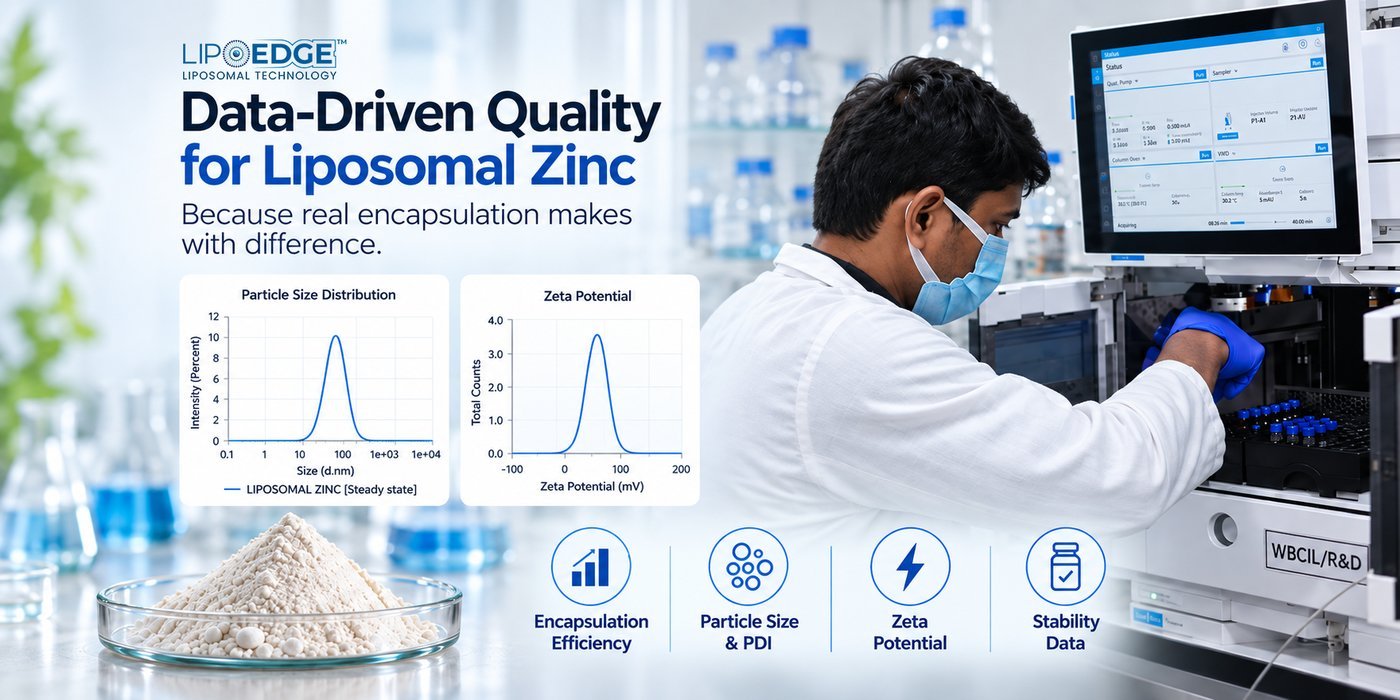
The liposomal zinc supplement market has no mandatory vesicle verification requirement; any product containing zinc and phospholipids can carry a liposomal label without demonstrating actual encapsulation. For brands sourcing liposomal zinc formulations, this creates a quality problem that price, certifications, and supplier claims cannot resolve on their own. The gap between a genuine liposomal zinc formulation and a lecithin-zinc mixture marketed as liposomal is measurable, but only if you know which parameters to request and what the data should show.
In this blog, we walk through exactly how to tell the difference before you commit.
Key Takeaways:
- Industry-accepted encapsulation efficiency for liposomal zinc is NLT 70%, verify your supplier’s batch-specific data against this benchmark before procurement
- PDI below 0.5 is the accepted criterion for liposomal zinc; values of 0.33 demonstrate tighter particle uniformity within this threshold
- Particle size alone does not establish whether a formulation is liposomal. Size distribution should be evaluated alongside appropriate structural and morphological characterisation.
Quick Answer: Verify liposomal zinc quality through encapsulation efficiency above NLT 70%, PDI below 0.5, and TEM-confirmed vesicle formation per batch.
Why Fake Liposomal Zinc Products Flood the Market
The liposomal zinc market has no verified labelling requirement for vesicle formation; Products marketed as liposomal may not always have rigorous physicochemical characterisation, making independent verification important.
- Mixing misconception: Simply blending zinc with sunflower lecithin produces a dispersion, not a liposomal formulation. True encapsulation requires high-pressure homogenisation, precise temperature control, and validated shear parameters that standard mixing equipment cannot achieve.
- Size threshold: Particles above 300 nm fall outside the accepted liposomal size range and are classified as macro-emulsions. The UK Committee on Toxicity has highlighted uncertainties in the physicochemical characterisation of some supplements marketed as liposomal.
- DLS requirement: A supplier who cannot provide dynamic light scattering data from production batches has not verified whether their product contains liposomes. Particle size and PDI confirmation is the minimum acceptable characterisation.
- Regulatory gap: No current FSSAI or CDSCO regulation requires verification of vesicle formation before a product carries a liposomal label, making unverified products commercially viable without quality consequence.
- Price signal: Premium pricing does not confirm encapsulation. Without encapsulation efficiency data above the NLT 70% industry benchmark, a price premium has no quality foundation.
Four Parameters That Define Liposomal Zinc Quality
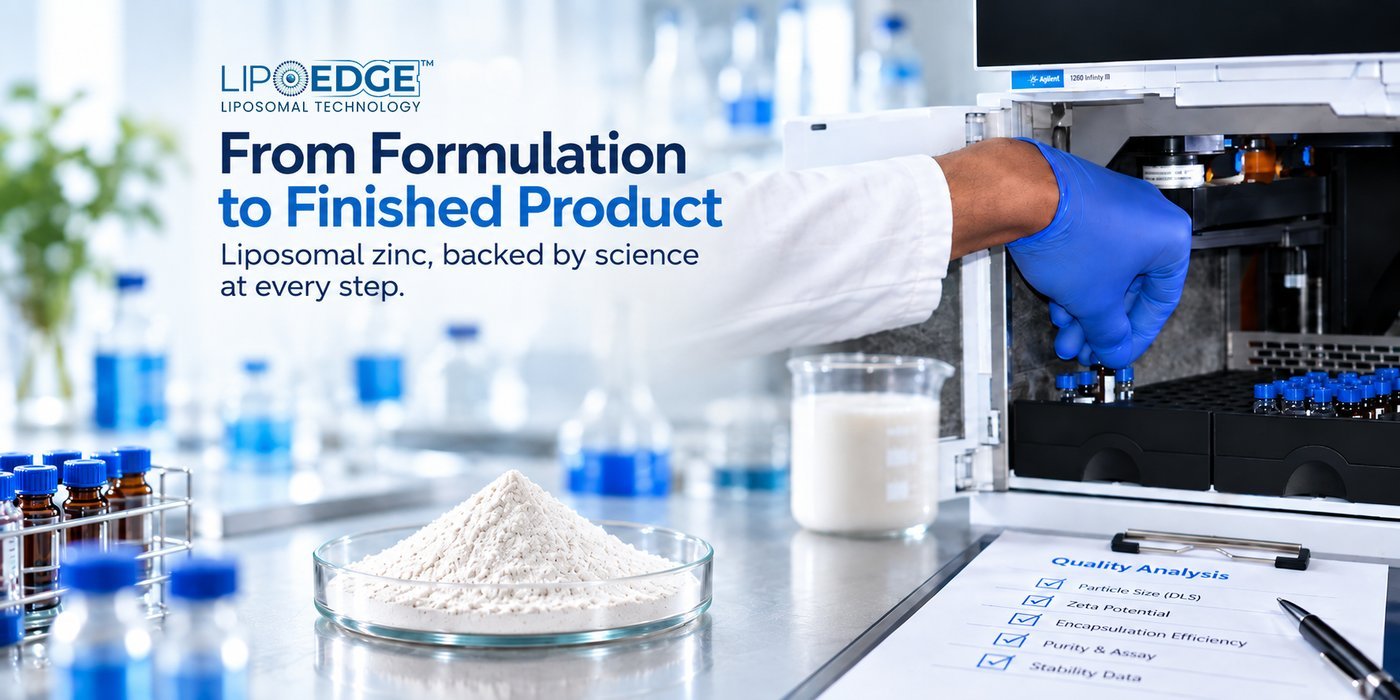
These four physicochemical parameters determine whether a liposomal zinc formulation meets pharmaceutical-grade quality standards, and each requires instrument-specific data, not summary values.
Encapsulation Efficiency
The industry-accepted benchmark for liposomal zinc encapsulation efficiency is at least 70%. Published characterisation data confirm WBCIL’s liposomal zinc achieves 94.51% encapsulation efficiency, significantly exceeding the industry minimum threshold through validated phosphatidylcholine encapsulation processes.
Particle Size
Accepted pharmaceutical liposomal particle size falls between 50-200 nm for optimal cellular absorption. Particles above 300 nm indicate macro-emulsion rather than true liposomal architecture, and their absorption profile differs substantially from genuine nanoscale vesicle systems.
Polydispersity Index
PDI below 0.5 is the accepted criterion for liposomal zinc formulations, values below 0.3 indicate tighter, more uniform particle populations. Published pharmaceutical guidance confirms that PDI values below 0.3 are commonly deemed acceptable in lipid-based drug delivery applications [1].
Zeta Potential
Zeta potential provides information about surface charge and can help assess colloidal stability when interpreted alongside other formulation characteristics. Stable colloidal systems maintain consistent zeta potential throughout shelf life; values outside the stable range signal vesicle instability that compromises encapsulation integrity over time.
Zinc Salt Selection and Formulation Compatibility
The zinc salt selected for liposomal encapsulation determines solubility, encapsulation compatibility, gastrointestinal tolerability, and the clinical evidence base your formulation can reference.
- Zinc oxide: Poor aqueous solubility creates specific encapsulation challenges requiring validated process parameters distinct from organic zinc salt protocols. Fractional absorption of 49.9% in unencapsulated form makes it the least suitable starting salt for liposomal zinc development.
- Zinc sulphate: Water-soluble with approximately 71% fractional absorption but associated with gastrointestinal irritation at supplemental doses. Published spray-dried liposomal zinc sulphate data confirms a PDI of 0.32 is achievable with appropriate stabilisers.
- Zinc glycinate: A 2024 narrative review in Nutrients confirmed zinc glycinate and zinc gluconate are better absorbed than other zinc forms across clinical evidence [2]. Its amino acid transporter absorption pathway differs from inorganic salts, a pharmacokinetic distinction relevant to liposomal delivery design.
- Zinc gluconate: Water solubility and established tolerability make it suitable for liquid liposomal formats. Zinc gluconate is an established zinc source used in a range of supplement and pharmaceutical formulations.
- Salt validation: A manufacturer validated for one zinc salt has not validated others. Request encapsulation efficiency, PDI, and stability data specific to your chosen salt.
What Six Months of Stability Evidence Shows
Six-month stability data can provide useful evidence of how a specific liposomal zinc formulation maintains relevant quality attributes under the tested storage conditions.
- Encapsulation integrity: Published six-month characterisation data for liposomal zinc confirms encapsulation efficiency remains consistent throughout the storage period. This demonstrates phospholipid bilayer integrity is preserved, with no significant zinc leakage over commercially relevant timelines.
- Assay consistency: Zinc content remained within specification across the full storage period, confirming the formulation does not degrade between manufacture and end use. Consistent assay values are what regulators and brand owners need from a stability dossier.
- Thermal stability: Testing under stress temperature conditions confirms manufacturing process integrity beyond standard storage parameters. Thermal stress results can identify potential formulation changes and help assess the robustness of the liposomal system under elevated-temperature conditions.
- Powder characteristics: Sieve analysis data confirms powder flow characteristics remain consistent throughout storage for capsule-filling applications. Particle agglomeration during storage is a practical manufacturing concern that stability data must address.
- Verifiable evidence: Manufacturers who publish stability characterisation in peer-reviewed literature provide independently verifiable data that internal COA reports cannot match. LipoEdge’s published liposomal zinc research represents the standard of transparency that procurement decisions should require from any supplier.
How to Verify Quality Before Supplier Commitment
Verifying liposomal zinc quality before committing requires specific documentation requests.
- Vesicle confirmation: Request TEM or cryo-TEM images from production batches confirming spherical phospholipid bilayer formation. DLS data alone does not verify liposomal architecture.
- Raw instrument data: Particle size, PDI, zeta potential, and encapsulation efficiency must include underlying instrument output—not summary COA values.
- Method validation: Request analytical method validation reports covering accuracy, precision, and specificity for zinc quantification specifically.
- GMP scope: Confirm GMP certification covers liposomal zinc specifically, not general mineral supplement manufacture.
- Stability specificity: Verify stability data covers your intended dosage form; liquid and powder liposomal zinc have distinct stability profiles requiring separate validation data.
Final Thoughts
Most brands discover formulation quality problems after launch, in customer complaints, retailer rejections, or regulatory queries they were not prepared for. The verification framework in this blog exists to move those discoveries earlier, before commercial commitment rather than after. Zinc salt selection, vesicle architecture, and stability data are not supplier concerns; they are brand owner decisions that determine product credibility in the market. India’s liposomal manufacturing landscape has matured to the point where peer-reviewed published characterisation data exists for specific formulations. If your brand’s claims are based on supplier evidence, that evidence can be independently verified.
References
- Dr. Poulami Gupta Banerjee, Dr. Atanuka Paul, Dr. Argha Chakraborty, Subrata Kundu (2025) LIPOSOMAL ZINC SUPPLEMENTATION FORMULATED BY WBCIL TO ENHANCE BIOAVAILABILITY AND THERAPEUTIC POTENTIAL IN HEALTH AND DISEASE MANAGEMENT. World Journal of Pharmaceutical Science and Research, 4(3), 1418-1435.
- Devarshi, P.P., Mao, Q., Grant, R.W. and Hazels Mitmesser, S. (2024). Comparative absorption and bioavailability of various chemical forms of zinc in humans: A narrative review. Nutrients, 16(24), p.4269. doi:10.3390/nu16244269.
The industry-accepted minimum is NLT 70% for liposomal zinc. Request batch-specific HPLC-verified encapsulation data, not supplier-stated averages or summary COA values.
PDI below 0.5 is the accepted criterion. Values around 0.33 indicate tighter particle uniformity; request raw DLS instrument output rather than summary COA values.
ICH Q1A studies measuring encapsulation efficiency and particle size at each time point are the minimum. For Indian supply chains, confirm that the data cover real shipping temperature conditions, not only laboratory storage profiles.
Request appropriate morphology and structural characterisation data, using techniques such as TEM or cryo-TEM where relevant to the formulation and development stage. DLS data confirms particle size but cannot independently verify liposomal architecture.
Zinc glycinate and zinc gluconate demonstrate better absorption than other zinc forms per a 2024 Nutrients review. Salt selection depends on dosage form; liquid formats suit gluconate, while powder applications suit sulphate with appropriate stabilisers.