Liposomal Iron Manufacturer: What Pharmaceutical Companies Should Consider
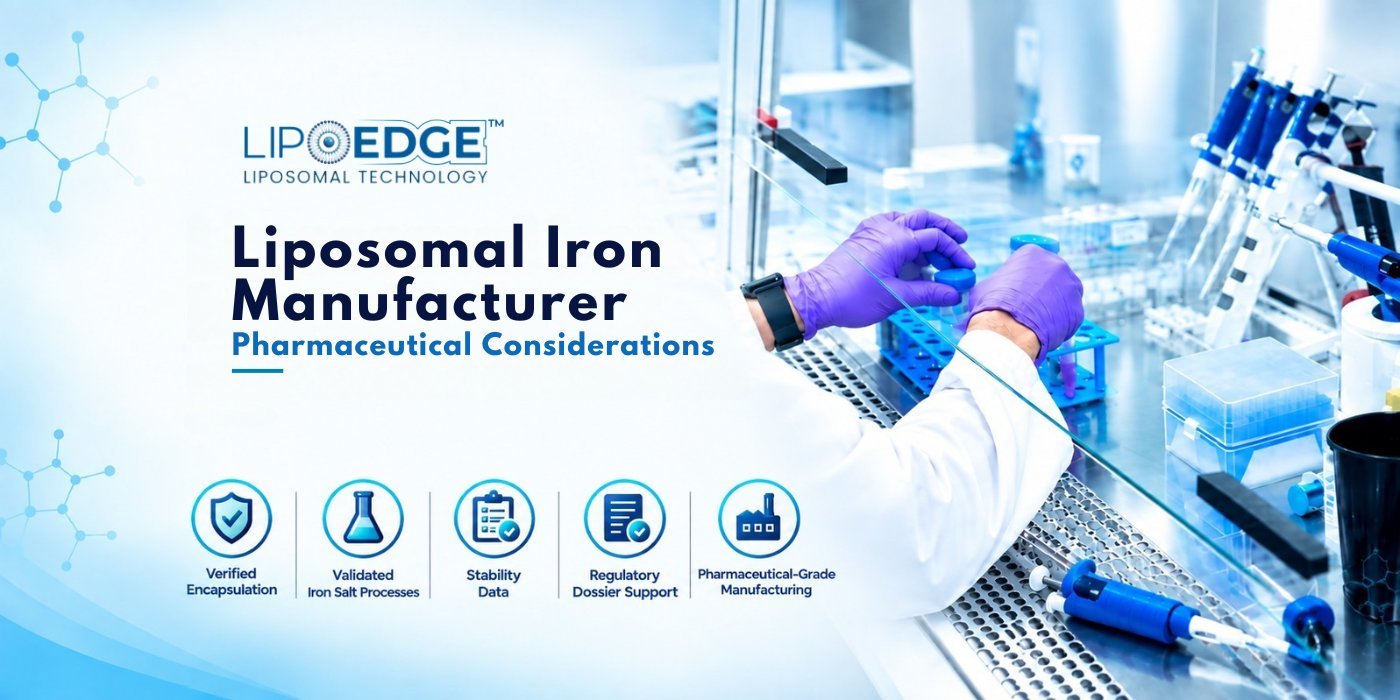
Choosing the wrong manufacturing partner for a liposomal iron product does not become obvious immediately; it shows up in failed regulatory submissions and batch rejections months later. The liposomal iron market in India has expanded rapidly, but the gap between genuine pharmaceutical-grade capability and encapsulation-claim suppliers is wider than most procurement teams realise. A liposomal iron manufacturer’s encapsulation process, iron salt portfolio, and dossier track record determine whether your product reaches the market or stalls in development. Getting this decision right requires a specific evaluation framework, not a standard supplier qualification checklist.
In this blog, we walk through what pharmaceutical companies in India should look for before committing to a liposomal iron manufacturing partner.
Key Takeaways:
- Iron salt selection determines absorption pathway, regulatory classification, and clinical evidence requirements for your specific liposomal iron product.
- Clinical evidence supports liposomal iron’s tolerability advantage most strongly at six months and in specific patient populations.
- Manufacturer evaluation must go beyond certifications, encapsulation verification, stability data, and dossier experience are non-negotiable requirements.
Quick Answer: A liposomal iron manufacturer must demonstrate verified encapsulation, validated iron salt processes, stability data, and dossier capability.
Why Liposomal Iron Is Now a Pharmaceutical Priority
India’s anaemia burden and conventional iron’s compliance failures have together created a clear pharmaceutical development case for liposomal iron formulations.
- India’s anaemia burden: NFHS-5 data confirms 67.1% of Indian children aged 6-59 months are anaemic. This figure increased from 58.6% in NFHS-4, indicating that existing supplementation programmes are not achieving adequate population-level outcomes.
- Conventional iron’s problem is tolerability: Up to 50% of patients on oral iron salts report gastrointestinal side effects. Treatment discontinuation drives persistent iron deficiency in populations who need long-term supplementation.
- Liposomal iron & absorption mechanism: Phospholipid encapsulation enables iron delivery through endocytosis and M-cell transcytosis pathways. This reduces direct gastric mucosal contact with free iron ions, the primary driver of gastrointestinal intolerance.
- Clinical evidence: A 2025 Indian RCT found ferrous ascorbate produced greater haemoglobin improvement than liposomal iron at one month [1]. The liposomal group demonstrated better tolerability and compliance; the study authors recommend further research with larger samples.
Iron Salt Selection: The Decision Brands Get Wrong
Most brands treat liposomal iron as a single ingredient. The iron salt selected for encapsulation determines absorption pathway, regulatory classification, and clinical evidence requirements.
Ferric Pyrophosphate: Most Clinically Studied
In unencapsulated form, India’s National Institute of Nutrition confirmed 0% iron absorption from ferric pyrophosphate. Liposomal encapsulation resolves this through endocytosis and M-cell transcytosis, bypassing gastric dissolution. Its taste-neutral profile makes it the preferred salt for paediatric liquid formulations and liposomal iron development in food fortification applications.
Ferrous Bisglycinate: Distinct Absorption Pathway
Ferrous bisglycinate enters intestinal cells through a peptide transporter. This distinct mechanism suits adult oral solid dosage forms and liposomal iron supplement applications.
Ferrous Ascorbate: Regulatory Positioning in India
Published National Institute of Nutrition data confirms ferrous ascorbate bioavailability at 30.6% [2]. Its liposomal form targets India’s prescription pharmaceutical segment under CDSCO Schedule K classification. A liposomal iron manufacturer supplying ferrous ascorbate must hold pharmaceutical manufacturing authorisation. FSSAI nutraceutical registration alone does not cover entry into the prescription market.
What This Means for Manufacturer Selection
A manufacturer offering only one iron salt cannot support your full product portfolio. Ferric pyrophosphate and ferrous bisglycinate encapsulate differently because of their distinct solubility profiles and lipid compatibility. Your regulatory dossier requires bioavailability data specific to your registered salt. Generic liposomal iron absorption studies do not satisfy CDSCO or FDA CMC submission requirements.
Clinical Evidence Pharmaceutical Teams Should Know
A 2025 RCT (Bahbah et al., Clinical and Experimental Paediatrics, 192 children aged 2-12 with IDA) compared liposomal SunActive iron against iron polymaltose complex over six months [3]. At six months, the liposomal group showed significantly greater improvements in haemoglobin, haematocrit, MCV, MCH, serum iron, serum ferritin, and transferrin saturation versus the conventional group (p < 0.001 across all parameters).
A separate 2026 paediatric CKD study (Hegazy et al., Pediatric Research, 60 patients) found oral liposomal iron at 30 mg/day produced outcomes comparable to IV iron dextran after three months, with 100% adherence and no reported adverse reactions [4]. The only population where oral iron matching IV performance has been demonstrated in published data.
Evaluating a Liposomal Iron Manufacturer Beyond the Brochure
Choosing a liposomal iron manufacturer requires evidence-based evaluation — not brochure claims about certifications or client counts.
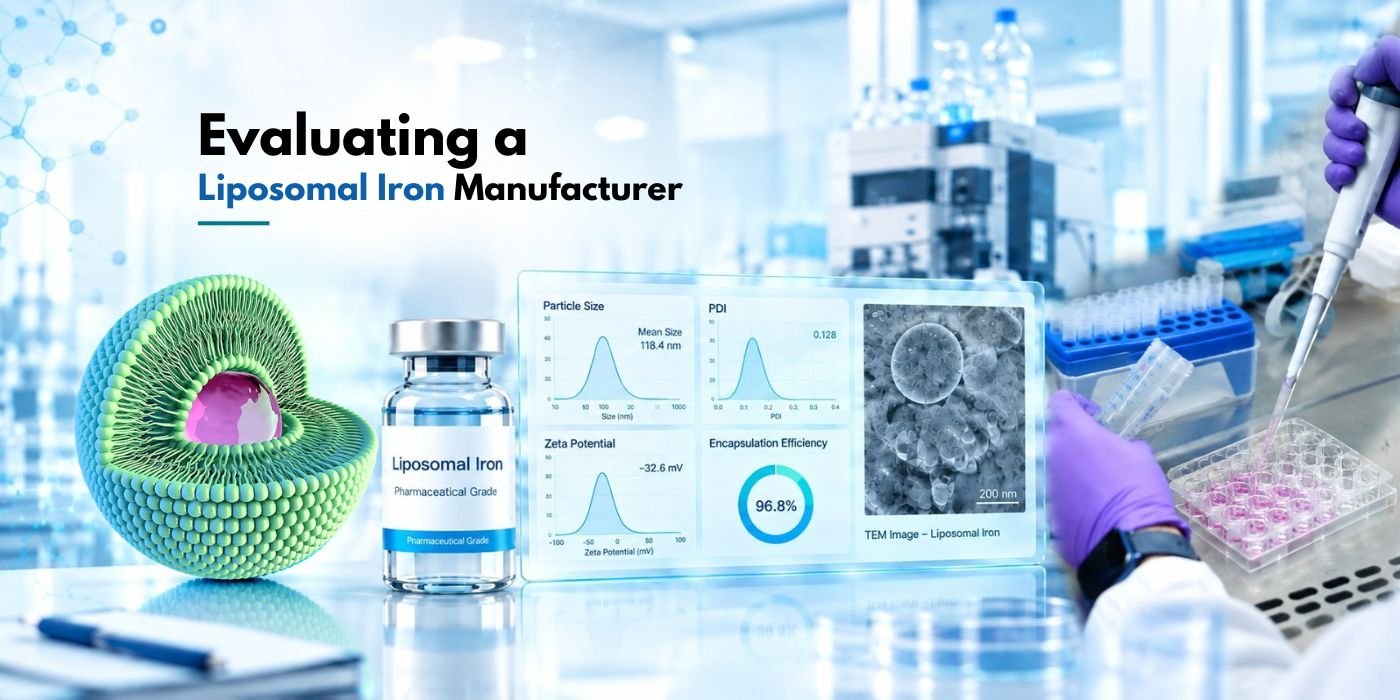
- Verify vesicle formation: Any liposomal iron supplier can claim encapsulation. Request TEM or cryo-TEM images confirming actual spherical vesicle formation from production batches.
- Request instrument-specific batch data: Particle size, PDI, zeta potential, and encapsulation efficiency must come with raw instrument output. Summary COA values without underlying DLS and HPLC data cannot support your regulatory submission.
- Confirm iron salt-specific process validation: Liposomal iron development varies by salt. A manufacturer validated for ferric pyrophosphate encapsulation has not necessarily validated processes for ferrous bisglycinate or ferrous ascorbate.
- Assess stability data against ICH guidelines: Liposomal iron suppliers must provide ICH Q1A/Q1B stability data measuring encapsulation efficiency and particle size at each time point.
- Evaluate regulatory dossier: Ask which markets the manufacturer has supported with liposomal iron submissions. A supplier without CDSCO, FDA, or export dossier experience cannot support your product’s registration pathway.
Also read: Clean Label Iron Supplements: The Liposomal Iron Advantage.
India’s Liposomal Iron Supply: A Sourcing Perspective
India’s pharmaceutical API infrastructure gives domestic brands a genuine sourcing advantage for liposomal iron that international suppliers cannot replicate at equivalent cost or regulatory depth.
- Vertical integration matters: Suppliers who synthesise iron salts before encapsulation maintain quality control across the entire chain. Sourcing liposomal iron from a manufacturer who imports ferric pyrophosphate externally introduces a quality gap your CDSCO dossier will expose during review.
- FSSAI vs Schedule K: The regulatory classification of your liposomal iron supplement determines which manufacturing licence your supplier must hold. Brands launching prescription products under Schedule K cannot source from FSSAI-only certified suppliers without creating a registration barrier before launch.
- Container stability: Indian export routes regularly expose pharmaceutical cargo to internal temperatures between 40-65 °C. Confirm your supplier’s liposomal iron absorption and encapsulation data cover these conditions, not only controlled laboratory storage profiles.
- Patents signal capability: Suppliers holding granted patents on solvent-free liposomal iron encapsulation demonstrate documented process innovation. This distinction directly supports the liposomal iron benefits and bioavailability claims your brand makes in regulated Indian markets.
- Export dossiers confirm domestic readiness: A supplier who has supported FDA, EMA, or GCC submissions has demonstrated the analytical standard your CDSCO filing requires. Request specific market dossier references, not general compliance statements.
Final Thoughts
Before shortlisting any liposomal iron manufacturer, request TEM-confirmed vesicle images, instrument-specific batch data, and stability profiles under real shipping conditions. The iron salt your manufacturer validates determines which product categories and regulatory pathways are genuinely available to your brand. Clinical evidence for liposomal iron is strongest at six months and in specific populations. Build your product brief around what the published data supports, not general bioavailability claims.
India’s sourcing landscape offers real advantages through vertical integration, patent-protected processes, and export-grade regulatory infrastructure, but those advantages need verification, not assumption. Established manufacturers like WBCIL, whose LipoEdgeTM platform combines pharmaceutical-grade encapsulation with multi-market dossier capability, represent the standard this evaluation process is designed to identify.
References
- Rangaraj S, Suresh P, Sundar S, Raju P. Liposomal Iron vs. Conventional Iron in the Treatment of Iron Deficiency Anemia in Children: A Randomized Controlled Trial. Cureus. 2025 Nov 18;17(11):e97183. doi: 10.7759/cureus.97183. PMID: 41431535; PMCID: PMC12718472.
- Kriplani, A., Pal, B., Bhat, V. and Swami, O. (2021). Ferrous ascorbate: Current clinical place of therapy in the management of iron deficiency anemia. Journal of South Asian Federation of Obstetrics and Gynaecology, 13(3), pp.103–109. doi:10.5005/jp-journals-10006-1896.
- Bahbah, W.A., Younis, Y.A.H.S., Elbelouny, H.S. and Mahmoud, A.A. (2025). Liposomal SunActive versus conventional iron for treatment of iron-deficiency anemia in children aged 2-12 years: A prospective randomized controlled trial. Clinical and experimental pediatrics, [online] 68(8), pp.608–615. doi:10.3345/cep.2025.00262.
- Hegazy SK, Koura MSE, Elharoun MS. Liposomal iron dramatic effect on chronic kidney disease pediatric anemia: a randomized clinical trial. Pediatr Res. 2026 Mar;99(4):1541-1547. doi: 10.1038/s41390-025-04418-x. Epub 2025 Sep 30. PMID: 41028503; PMCID: PMC13102721.
WHO-GMP and cGMP certifications are the minimum requirements for pharmaceutical-grade liposomal iron supply to regulated export markets. For India-specific prescription products under Schedule K, CDSCO pharmaceutical manufacturing authorisation is additionally required beyond FSSAI registration alone.
Ferric pyrophosphate is the most clinically studied iron salt in paediatric liposomal applications due to its taste-neutral profile. Its poor solubility in unencapsulated form makes phospholipid encapsulation essential and directly determines which manufacturer processes suit your product.
Liposomal iron formulations for therapeutic use fall under CDSCO’s complex drug product framework and require more detailed CMC documentation. Post-registration changes to formulation, manufacturing process, or production scale require prior approval supplements, unlike standard conventional iron salt registrations.
Request TEM or cryo-TEM images from actual production batches confirming spherical unilamellar vesicle formation as standard documentation. Suppliers who cannot provide electron microscopy data from production batches have not verified actual vesicle formation in their product.
ICH Q1A and Q1B stability studies measuring encapsulation efficiency and particle size at each time point are the minimum requirement. For Indian supply chains, verify that stability data covers shipping temperatures between 40 and 65 degrees Celsius, not only controlled laboratory storage conditions.