7 Checkpoints to Evaluate a Liposomal Ingredient Supplier
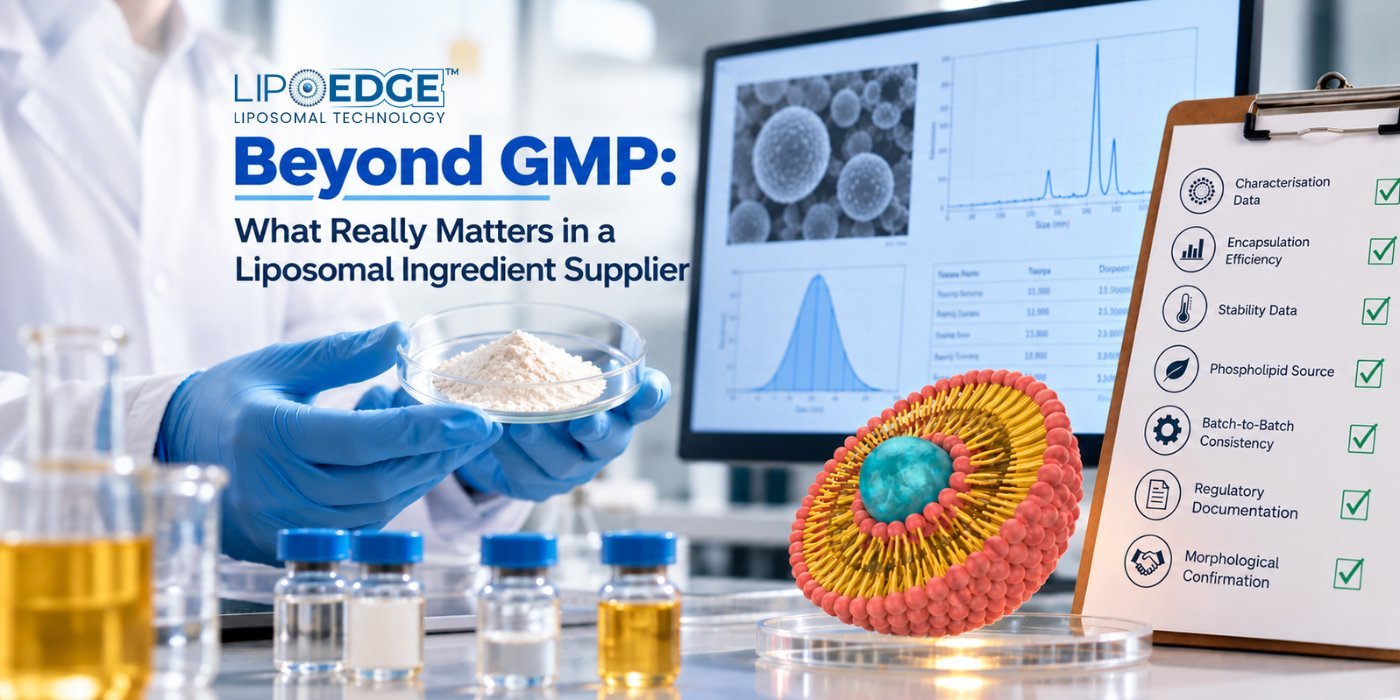
Most formulation teams treat GMP certification as the primary filter for sourcing liposomal ingredients. It is understandable because GMP is visible, auditable, and familiar. But a GMP-certified facility can manufacture a liposomal ingredient with a PDI above 0.3, no validated EE% method, and zero stability data on file, and remain fully compliant. The technical variables that determine whether a liposome product performs consistently sit entirely outside GMP.
In this blog, we break down seven technical checkpoints that actually determine supplier reliability and what to ask before a sourcing decision is finalised.
Key Takeaways:
- GMP certification confirms facility compliance, not liposomal characterisation capability or batch reproducibility.
- EE% without a stated analytical method is unverifiable and not comparable across liposomal ingredient suppliers.
- Stability trend data across consecutive batches is stronger evidence of process control than a single passing CoA.
Quick Answer: A reliable liposomal ingredient supplier provides validated characterisation data, ICH Q1A stability reports, phospholipid sourcing documentation, and a CTD-format technical dossier.
GMP Certifications Alone Are Not Enough
GMP certifications are critical to audit the facility’s overall processes and records. However, the certificate is not useful when it comes to individual product quality
- GMP audits the process, not the product. A batch can pass GMP release without a single DLS measurement, EE% validation, or stability data point on file.
- GMP sets no minimum testing frequency. A certified facility can characterise one batch per quarter and remain fully compliant.
- GMP does not govern analytical method selection. Choosing spectrophotometry over HPLC for EE% measurement is the supplier’s decision. No GMP requirement flags the difference or its consequences.
- GMP does not evaluate phospholipid sourcing. PC purity grade, raw material origin, and feedstock CoA availability sit entirely outside what any GMP audit covers or requires.
Next, let’s review the seven critical quality checkpoints vital for a liposomal ingredient supplier.
7 Checkpoints For Evaluation of Liposomal Ingredient Supplier
Selecting a liposomal ingredient supplier based on GMP certification alone misses the technical variables that determine whether a liposome product performs consistently across batches.
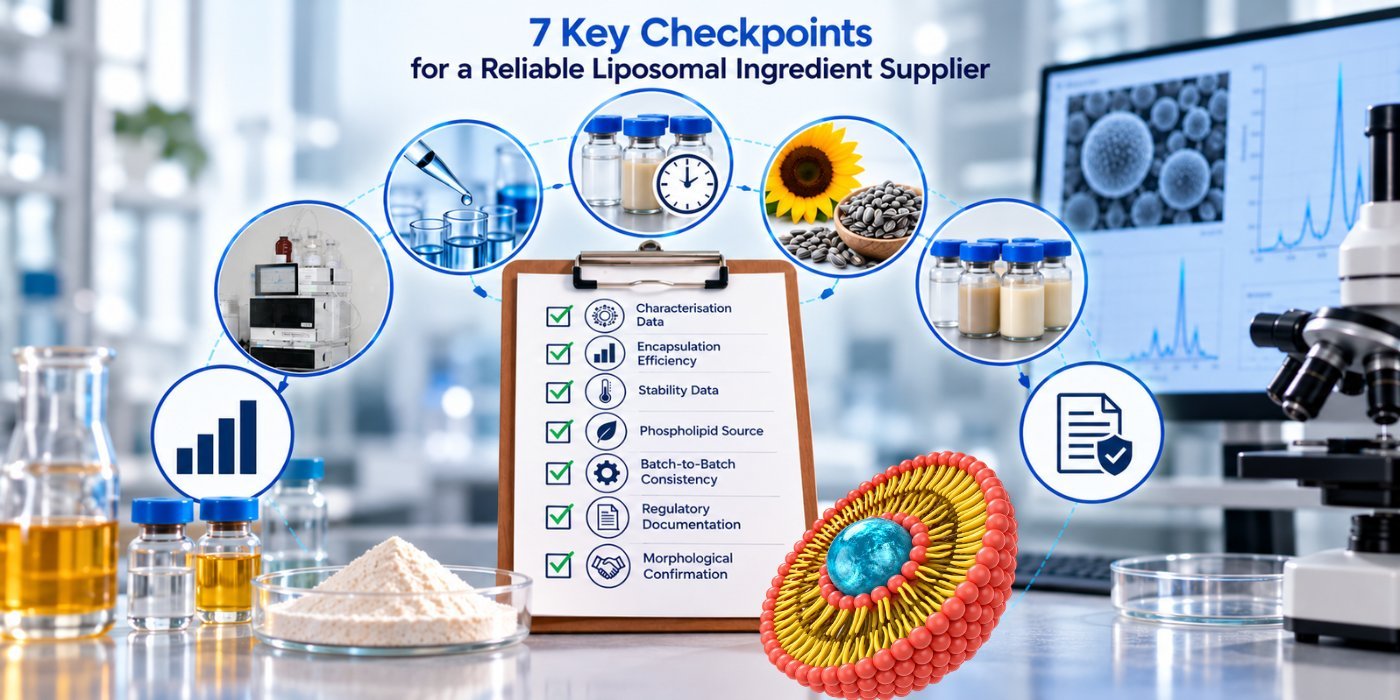
Here are seven checkpoints to look at to evaluate a liposomal manufacturer:
1. Characterisation Data
Ask whether the supplier runs DLS, HPLC, FTIR, and ICP-MS in-house or sends samples to a third-party lab. In-house capability shortens batch release time and creates tighter process feedback loops. A supplier dependent on outsourced testing cannot control how quickly it identifies and corrects quality deviations.
2. Encapsulation Efficiency (EE) Method
EE% data is often misunderstood in liposomal ingredient sourcing. UV-visible spectrophotometry cannot separate encapsulated material from surface-adsorbed or free active material. Moreover, lipid scattering often interferes with absorbance readings and inflates results. HPLC (high-performance liquid chromatography) with vesicle disruption eliminates this interference by separating the drug from lipid peaks before quantification. It is therefore the industry standard method for accurate EE% calculation. Ask which method a supplier uses and whether the process is validated to ICH Q2 (R2) parameters.
3. Stability Data
Stability and stress testing for each lipid molecule determine the degradation profile. Parameters include light exposure, pH, and oxygen, and stability determination includes physicochemical properties such as particle size and size distribution. The data help identify appropriate storage conditions and retest periods. Request ICH Q1A accelerated and real-time stability reports across three consecutive batches.
4. Phospholipid Source and PC Purity
Both PC (phosphatidylcholine) purity and phospholipid source are rarely shown in the final CoAs. However, these data are critical for assessing encapsulation reproducibility and bilayer integrity. Commercially, a PC purity above 90% signifies stable unilamellar vesicle formation. Sunflower lecithin is allergen-free and suitable for clean-label applications. Ideally, a buyer should request a raw material CoA as a standard qualification document.
5. Batch-to-Batch Consistency
It is very difficult to determine batch consistency through a single batch result. To evaluate consistency, you need parameters such as PDI and zeta potential across five or more consecutive production batches. Variance of more than 10% in zeta potential across batches shows an uncontrolled process variable. For most buyers and liposomal manufacturers, batch consistency data is the most critical evidence of manufacturing reproducibility.
6. Regulatory Documentation
A CTD-format technical dossier is necessary for FSSAI, US NDI and EU Novel Food submissions. Buyers should ask whether a supplier holds a Drug Master File or has an equivalent documentation package. Suppliers that produce characterisation data on request put pressure on formulation teams at most companies, extending the overall regulatory submission timeline. Lipoedge delivers regulatory-compliant (cGMP) data, and our scientific team has experience in a broad range of liposomal applications, from small molecules to large molecules such as proteins and monoclonal antibodies.
7. Morphological Confirmation
DLS (dynamic light scattering) provides information on particle diameter; however, it cannot distinguish between a well-formed vesicle and a fused aggregate. In such cases, SEM and Cryo-TEM images confirm actual vesicle architectures. Characteristics such as a spherical bilayer structure, the absence of drug crystallisation, and unilamellar versus multilamellar structure quantify morphological specifications.
What Separates a Liposomal Ingredient Supplier From a Contract Manufacturer
The difference matters during any quality event or regulatory submission that requires traceable characterisation data.
- A contract manufacturer executes your specification. If the specification is incomplete, the product reflects that gap. Characterisation data is tailored to customer requirements, not an independent quality framework.
- A liposomal ingredient supplier owns the formulation, the characterisation protocol, and the manufacturing process. The supplier owns the acceptance criteria, analytical methods, and technical dossier. Therefore, the supplier is accountable for a failing batch.
- Batch reproducibility is measurable evidence of this difference. Controlled liposome manufacturing demonstrates particle size relative standard deviation of 2.5% at production-relevant volumes, with PDI consistently below 0.2.
- A contract manufacturer has no structural reason to track PDI and zeta potential trends across consecutive batches unless the buyer demands it. A liposomal ingredient supplier maintains this data as standard documentation.
- For regulatory submissions, a liposomal ingredient supplier holds a CTD-format technical dossier, whereas a contract manufacturer does not follow such protocols. That documentation gap alone can directly affect your submission timeline and reduce production efficiency.
Liposome Characterisation for Drug Delivery
Appropriate assessment for liposomal drug specifications includes several parameters, and Lipoedge’s team provides both formulation and analytical support to help you address the following:
- Physicochemical parameters include particle size, size distribution, physical stability, and zeta potential.
- Liposomal-contained and free drug substance.
- Lipid content, which reflects overall consistency with the intended formulation.
- Residual solvents, for formulations that use organic solvents in liposome manufacturing.
- Total drug substance content, as labelled by the manufacturer.
- In vitro release of drug substances from the liposomal drug products.
Final Thoughts
Before shortlisting a liposomal ingredient supplier, request stability data across at least three consecutive batches. Ask for the phospholipid CoA and confirm PC purity grade above 90% before committing to a supply agreement. If the product will enter a regulated market, confirm the supplier holds a CTD-format technical dossier before your formulation team begins development work. A supplier that cannot provide morphological confirmation or a validated EE% method is not equipped to meet the documentation requirements of a regulatory submission.
LipoEdge maintains batch-specific characterisation data, ICH Q1A stability reports, and full technical dossiers as part of its standard supplier package.
References
-
SciMed (2026). Liposome synthesis & size characterisation using microfluidics & high‑precision DLS – Scimed Liposome synthesis & size characterisation using microfluidics & high‑precision DLS.
A supplier owns the formulation, characterisation data, and technical dossier. A contract manufacturer produces to your specification. If that specification is incomplete, the product reflects it.
Request ICH Q1A accelerated and real-time data across a minimum of three consecutive batches. Single-batch stability confirms one result, not process reproducibility.
Particle size reports a mean. PDI reports the distribution width. A PDI above 0.3 means the batch contains vesicle subpopulations that absorb at inconsistent rates across production runs.
No. GMP audits facility processes, not analytical capability. Validated EE% methods, stability programmes, and morphological confirmation sit outside what any GMP audit evaluates.
PC purity above 90% is the accepted threshold. This sits on the phospholipid feedstock CoA, not the finished product CoA, and must be requested separately.