What a Liposomal CoA Actually Tells Your Formulation Team
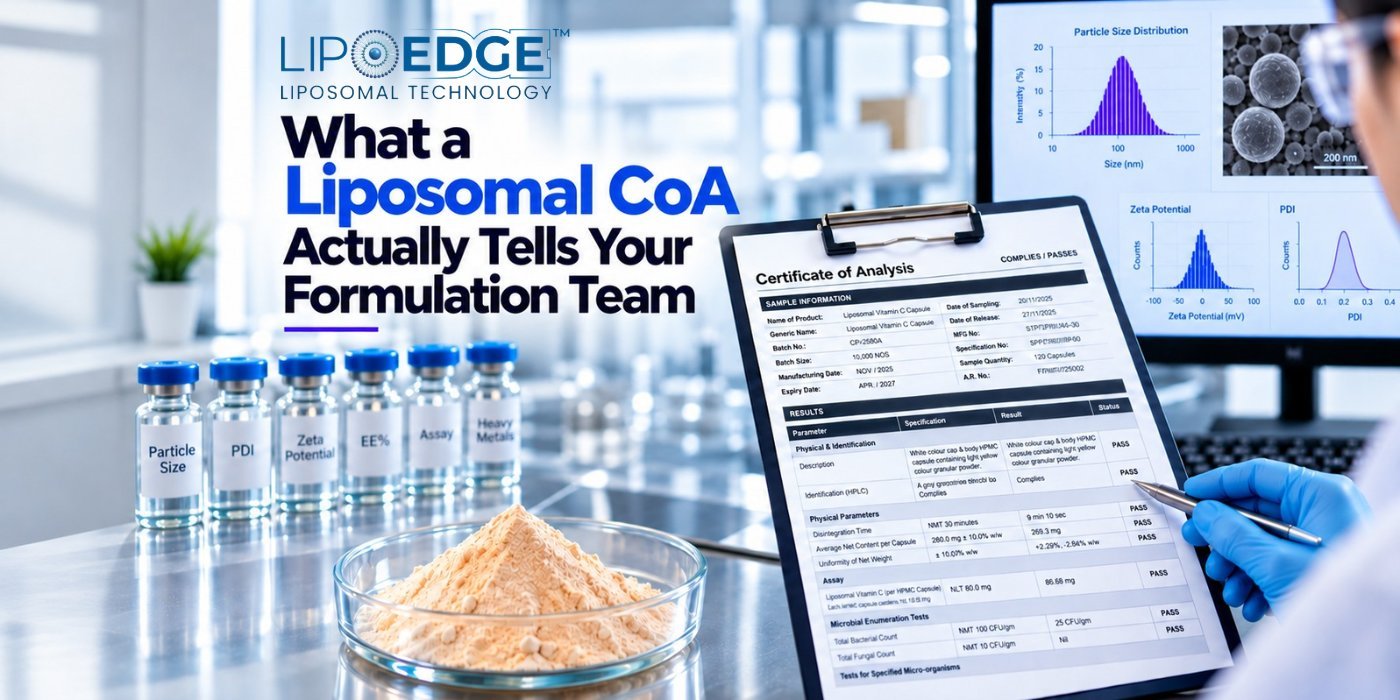
A liposomal CoA records six batch-specific test results. It confirms conformance to supplier-defined specifications at the time of manufacture. It does not confirm process control, batch reproducibility, or shelf-life performance. EE% is only valid when the analytical method is stated. Zeta potential below −30 mV is the minimum stability threshold. PDI above 0.3 signals vesicle heterogeneity. Heavy metal results missing from a mineral-loaded CoA mean the test was not run.
Key Takeaways:
- A liposomal CoA confirms one batch passed the supplier’s own specifications. It does not confirm the next batch will match.
- Zeta potential above −30 mV predicts aggregation risk under storage and GI transit conditions.
- PDI above 0.3 produces inconsistent absorption kinetics across batches.
- Missing heavy metal data on a mineral-loaded CoA means testing was not performed, not that results were clean.
Quick Answer: A liposomal CoA contains six batch results against supplier specs. It does not confirm process control, reproducibility, or shelf-life performance.
What a Liposomal CoA Actually Tells Your Formulation Team
A liposomal CoA records what was measured in one batch. It does not confirm how the next batch will perform.
- A CoA confirms that one batch met the supplier’s own specifications at the time of manufacture. Specifications are set by the supplier, so a result at the acceptance boundary technically passes.
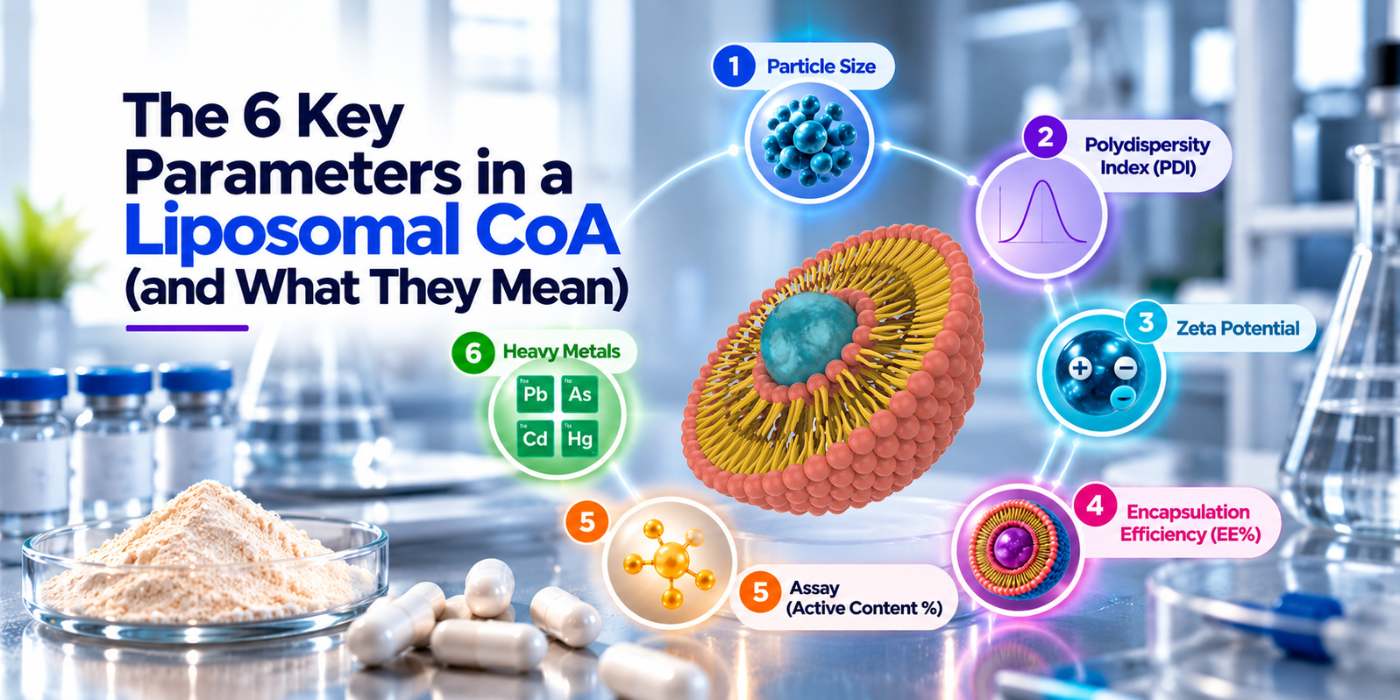
- Six parameters define liposomal quality: particle size, PDI, zeta potential, encapsulation efficiency, assay, and heavy metals. Each requires a specific interpretation framework that raw numbers alone do not provide.
- EE% without a stated analytical method is unverifiable. HPLC with vesicle disruption and spectrophotometry produce different values for the same batch.
- A passing CoA does not confirm the next batch will perform identically. Reproducibility requires batch records, process validation data, and multi-batch trend reports.
- Heavy metal results absent from a CoA do not indicate compliance. They indicate the test was not performed. Mineral-loaded liposomal ingredients require ICP-MS testing on every batch.
The Critical 6 Parameters on a Liposomal CoA
Every liposomal CoA reports six parameters. Each one answers a specific formulation question.
1. Particle Size (nm)
Measured by dynamic light scattering, particle size reports the vesicle’s mean hydrodynamic diameter. Pharmaceutical-grade oral liposomes sit below 300 nm. Sizes above this threshold reduce lymphatic uptake eligibility and intestinal membrane interaction.
2. Polydispersity Index (PDI)
PDI measures the width of the size distribution, not the size itself. A PDI above 0.3 indicates a heterogeneous vesicle population. Batches with inconsistent size ranges produce unpredictable absorption kinetics across manufacturing processes.
3. Zeta Potential (mV)
Zeta potential measures the surface charge that prevents vesicle aggregation. Values below −30 mV indicate adequate colloidal stability. Readings between −20 and −30 mV indicate an increased risk of aggregation during transit and GI pH exposure.
4. Encapsulation Efficiency (EE%)
EE% states the fraction of active ingredient enclosed within the vesicle. The analytical method used, HPLC or spectrophotometry, directly affects the result. A CoA without a stated method cannot be verified or compared across suppliers.
5. Assay (Active Content %)
Assay reports total active content, encapsulated plus free, against label claim. Acceptance is typically 95-105%. A batch can pass assay while carrying most of its active in free, unencapsulated form with poor absorption potential.
6. Heavy Metals
Heavy metal results confirm ICP-MS testing. For mineral-loaded liposomes, zinc, magnesium, and iron, the mineral API itself introduces contamination risk that phospholipid-only products do not carry.
Next, let’s understand what standard liposomal CoA do not carry.
What a Standard Liposomal CoA Does Not Include
A liposomal CoA confirms what was tested. It does not document what was omitted, and omissions carry as much formulation risk as failing results.
- A CoA confirms encapsulation but says nothing about how the active releases under simulated gastric or intestinal conditions. That requires separate in vitro dissolution studies.
- The PC content of the lecithin feedstock directly governs bilayer integrity and encapsulation reproducibility. This information sits on the raw material CoA for the phospholipid source, which must be requested separately.
- A single batch result is a point-in-time measurement. ICH Q1A real-time and accelerated stability reports show how particle size, PDI, and zeta potential behave across 6, 12, and 24 months. Without these, shelf-life claims are not supported by data.
- ICH Q3C limits govern permissible ethanol levels in finished products. Absence of this data from the CoA does not confirm compliance.
- Morphological confirmation via cryo-TEM or SEM is rarely part of a standard CoA. These images reveal fused vesicles, drug crystallisation outside the bilayer, and structural defects that DLS cannot detect.
5 CoA Red Flags That Should Stop a Supply Decision
A CoA that passes every listed parameter can still represent a batch unsuitable for formulation. Reject or escalate on any of these five findings before finalising a supply decision.
1. EE% Without a Method
Spectrophotometric methods overestimate encapsulation by 15-25% against HPLC-based vesicle disruption. Without a stated method, your team cannot verify the figure or compare it against a previous batch or competing supplier.
2. Zeta Potential Above −30 mV
Demand supporting stability data when zeta potential liposome readings fall above −30 mV. A 2022 study confirmed that formulations above this threshold aggregate progressively under standard storage conditions [1].
3. PDI Above 0.3, Unexplained
Reject batches where the supplier cannot identify the process variable that pushed PDI above 0.3. Heterogeneous vesicle populations produce inconsistent absorption kinetics that invalidate clinical substantiation data across runs.
4. Heavy Metals Off a Mineral raw material COA
Require ICP-MS results on every mineral-loaded batch. Zinc, magnesium, and iron liposomal ingredients introduce contamination routes that phospholipid-only systems do not carry.
5. No Lot Number on a COA for Supplements
Reject any COA for supplements that carries no traceable lot number. Without it, your team has no manufacturing record to investigate when a quality event occurs post-formulation.
What to Ask Your Liposomal Supplier Beyond the CoA
Most suppliers will send a CoA without being asked. The information that supports a sourcing decision rarely arrives unless you ask for it specifically. Stability reports show whether particle size and zeta potential hold over 12 to 24 months. The phospholipid feedstock CoA tells you the PC purity grade, which the finished product CoA almost never states. For mineral-loaded liposomes, ask whether ICP-MS runs on every batch. LipoEdgeTM provides this documentation as part of its standard technical package.
Final Thoughts
Formulation teams that read a CoA correctly make better sourcing decisions. Each of the six parameters on a liposomal CoA carries a pass condition that the number alone does not explain. A supplier who cannot provide stability trend data, phospholipid feedstock documentation, or morphological confirmation alongside the CoA has not completed the technical package. That gap is worth identifying before a product enters development, not after a batch fails in-process or post-launch. The CoA is one document in a larger qualification file. Treat it as the opening question, not the final answer.
References
-
Nsairat, H., Khater, D., Sayed, U., Odeh, F., Al Bawab, A. and Alshaer, W. (2022). Liposomes: Structure, composition, types, and clinical applications. Heliyon, [online] 8(5), p.e09394. doi:10.1016/j.heliyon.2022.e09394.
It measures the fraction of active enclosed within the vesicle at manufacture. It does not reflect encapsulation integrity after downstream processing, blending, or shelf ageing.
Yes. CoA specifications do not account for the pH, ionic strength, or shear conditions of your manufacturing process. Conformance to supplier limits does not guarantee performance in your product matrix.
ICH Q1A requires accelerated testing at 40°C and 75% RH for six months alongside real-time data at intended storage conditions. Stability run only at product launch, without ongoing batch-level testing, does not support current shelf-life claims.
Particle size is a static measurement. Zeta potential predicts whether that size will hold. Low surface charge allows vesicles to aggregate progressively without any visible change in the bulk product.
A raw material CoA covers the phospholipid feedstock, PC purity, peroxide value, and identity. A finished liposomal CoA covers the encapsulated ingredient. Both are required for complete supplier qualification; one does not substitute for the other.