How to Choose a Liposomal Calcium Manufacturer for Your Supplement Brand
Standard supplement procurement treats calcium as a commodity ingredient. Liposomal calcium is not. The calcium salt selected for encapsulation, the phospholipid source, the drying process, and the manufacturer’s analytical infrastructure each determine whether your finished product performs as labelled and holds up under regulatory review. Getting these decisions wrong doesn’t surface immediately; it shows up in failed claims substantiation, unstable batches, and dossier rejections.
In this blog, we walk through what supplement brands should evaluate before committing to a liposomal calcium manufacturer.
Key Takeaways:
- Calcium salt selection can influence elemental calcium content, formulation characteristics, and the evidence and specifications relevant to your product.
- Liposomal calcium’s bone health claim rests on calcium’s established evidence base; bioavailability differentiation requires your formulation’s own characterisation data.
- Manufacturer qualification must cover phospholipid source, powder format validation, and co-formulation compatibility beyond standard GMP checks.
Quick Answer: Choose a liposomal calcium manufacturer by verifying calcium salt validation, phospholipid source, encapsulation data, stability studies, and regulatory dossier experience.
Why Standard Calcium Sourcing Fails Liposomal Brands
Standard calcium procurement often focuses on assay, purity, moisture, and other basic specifications. For liposomal calcium, supplier qualification should also consider encapsulation performance, particle characteristics, phospholipid quality, stability, and product format.
- Encapsulation Efficiency: Review batch-specific encapsulation data where relevant. Encapsulation efficiency indicates the proportion of calcium associated with the liposomal system but does not by itself establish clinical bioavailability.
- Particle Size: Particle size distribution and PDI can help characterise liposomal systems. Select appropriate methods, such as Dynamic Light Scattering, based on the product and development stage.
- Phospholipid Quality: Assess phospholipid identity, purity, source, and relevant specifications. Establish the appropriate phospholipid during formulation development.
- Stability: Apply a stability programme appropriate to the formulation and packaging. Relevant studies may monitor assay, encapsulation, particle characteristics, and other quality attributes over time.
- Powder Format: For spray-dried or otherwise dried liposomal calcium, manufacturers should provide process-development and stability data showing that the selected drying process maintains relevant product characteristics during storage and handling.
Calcium Salt Selection: What Supplement Brands Get Wrong
The calcium salt selected for liposomal encapsulation determines elemental content, encapsulation compatibility, dosage form suitability, and legitimate claims support.
- Calcium carbonate is pH-dependent: It contains 40% elemental calcium but needs gastric acid to dissolve. Because calcium carbonate depends more on gastric acid for absorption, absorption may be reduced in people with low stomach acid.
- Calcium citrate absorbs independently: Calcium citrate is less dependent on stomach acid for absorption than calcium carbonate and may be useful when gastric acid production is reduced.
- Calcium glucoheptonate offers high solubility: Published pharmacokinetic data reported relative calcium bioavailability of approximately 92% compared with calcium carbonate within six hours [1].
- Encapsulation compatibility varies by salt: A manufacturer validated for calcium carbonate encapsulation has not necessarily validated calcium citrate processes. Verify encapsulation efficiency, particle size, and stability data separately for each salt you intend to source.
- Salt selection determines your regulatory dossier: The calcium salt you register defines analytical methods, reference standards, and specification limits.
Changing the calcium salt after registration may require a regulatory variation or other regulatory assessment, depending on the product and target jurisdiction.
Liposomal Calcium Benefits: What Brands Can Legitimately Claim
The distinction between what liposomal calcium delivers mechanistically and what your brand can claim on product labels is two separate questions, and confusing them creates regulatory and FTC exposure.
- Calcium’s claim: Calcium’s role in bone mineralisation is an established nutrient function recognised by FSSAI, EFSA, and FDA. Your bone health claim rests on calcium’s well-established evidence base. The liposomal delivery format supports the argument for better bioavailability — but bone health itself is the calcium claim, not a liposomal-specific one.
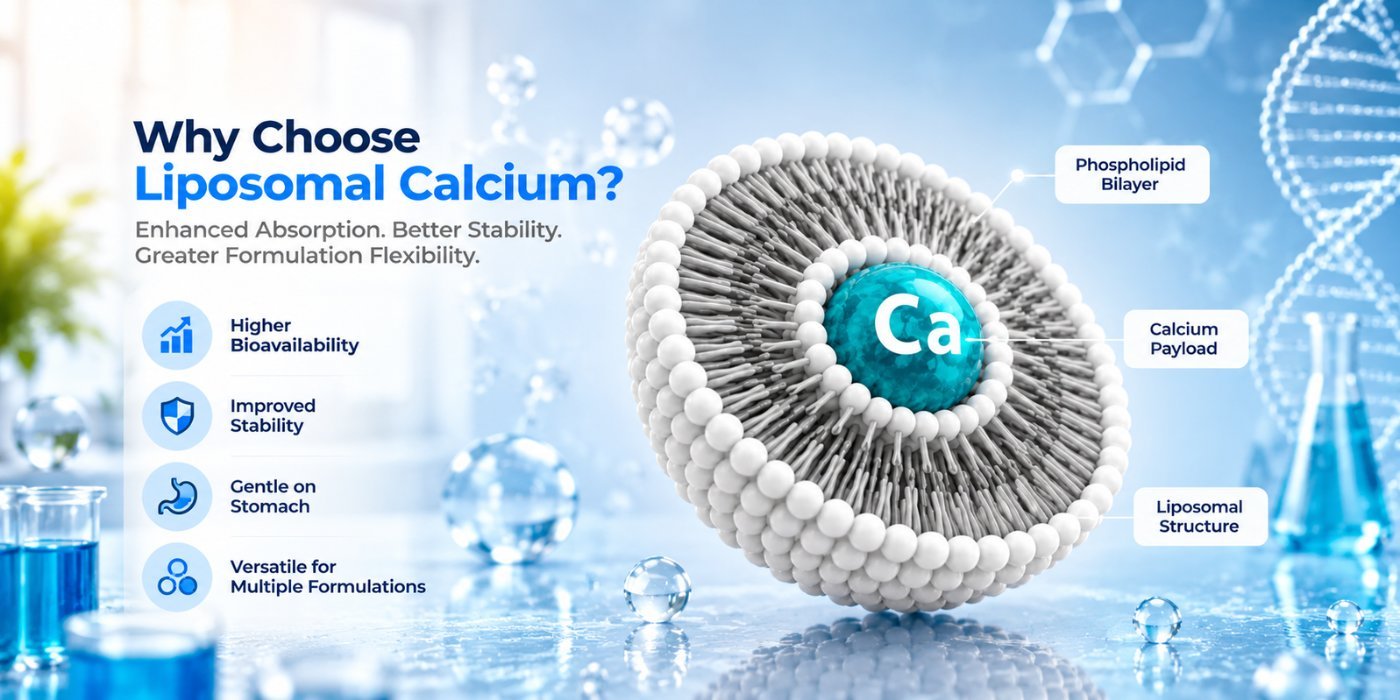
- Absorption pathway: Published research confirms liposomal calcium utilises endocytosis and paracellular transport pathways. A 2026 peer-reviewed review (Gupta Banerjee and Chakraborty, Public Health Open Journal) reports an encapsulation efficiency of 88% and a particle size of 142.5 nm for liposomal calcium systems. These findings provide formulation and mechanistic information, but claims of improved human bioavailability should be supported by appropriate comparative evidence for the relevant formulation.
- Tolerability distinction: Any tolerability advantage associated with liposomal delivery should be supported by appropriate comparative evidence for the relevant formulation.
- Calcium paradox: Published research identifies the calcium paradox — skeletal deficiency alongside vascular calcification risk from poorly absorbed calcium.
Liposomal delivery is being investigated as an alternative approach to calcium delivery, but any claims about improved absorption or cardiovascular effects should be supported by appropriate, formulation-specific evidence.
5 Criteria for Qualifying a Liposomal Calcium Manufacturer
These five criteria address what standard supplement procurement checklists do not cover for liposomal calcium specifically.
Phospholipid Source and Purity
The phospholipid determines vesicle stability, regulatory positioning, and clean-label compatibility. Sunflower-derived phosphatidylcholine avoids soy allergen concerns and suits non-GMO label claims. Request phospholipid identity, purity specification, and source documentation alongside the product COA.
Powder Format Validation
Spray-dried liposomal calcium requires validated drying parameters that preserve encapsulation integrity post-reconstitution. Request process development data specific to calcium confirming that the drying process maintains liposomal particle characteristics during storage and handling at commercial scale.
Development Batch Availability
Verify whether the manufacturer offers development-stage batches with full characterisation data before commercial MOQ commitments are required. Committing to commercial volumes before pilot batch validation confirms product viability creates unnecessary procurement risk.
Co-formulation Compatibility
Liposomal calcium is commonly combined with vitamin D3, vitamin K2, and magnesium. Request compatibility data confirming co-ingredients do not compromise vesicle integrity, particle size, or the calcium component’s encapsulation efficiency under your intended formulation conditions.
Technology Transfer Documentation
If you intend to scale or switch manufacturers, verify that the manufacturer provides a transferable technology package. This includes process parameters, critical quality attributes, and validated analytical methods—not proprietary processes that permanently bind your formulation to a single supplier.
India’s Liposomal Calcium Supply: A Sourcing Perspective
India’s liposomal calcium supply offers genuine advantages for supplement brands, but those advantages are manufacturer-specific, not geography-wide.
- Vertical integration: Manufacturers that synthesise calcium salts, source phosphatidylcholine, and encapsulate within a single supply chain eliminate quality gaps between steps. Verify whether your shortlisted supplier controls each stage or sources components externally.
- Dual-facility WHO-GMP: Manufacturers operating certified facilities across multiple locations may offer additional supply-continuity options, subject to site capability and qualification
- Granted patents signal process credibility: Granted patents can document claimed innovations in manufacturing or formulation processes. They do not by themselves establish clinical efficacy or substantiate bioavailability claims.
- Domestic market presence: Experience supplying domestic and export markets may provide useful evidence of familiarity with different regulatory requirements, but product-specific qualification remains necessary.
- COPPs confirm what compliance statements do not: Where applicable, Certificates of Pharmaceutical Product and other regulatory documentation can support assessment of a manufacturer’s regulatory status and supply eligibility.
Final Thoughts
Choosing a liposomal calcium manufacturer is a formulation decision before it is a procurement one. The calcium salt you select determines your absorption pathway, dosage form options, and regulatory dossier requirements, and your manufacturer must have validated processes for that specific salt. Verify the phospholipid source, powder-format validation, and co-formulation compatibility before commercial commitment. Build your product claims around what your specific formulation’s characterisation data supports, not generic liposomal calcium studies. India’s supply landscape offers real advantages through vertical integration and patent-protected processes, but only where those credentials are documented. Evaluate manufacturers against documented specifications, formulation data, analytical evidence, and applicable regulatory requirements.
References
- Wiria, M., Tran, H.M., Nguyen, P.H.B., Valencia, O., Dutta, S. and Pouteau, E. (2020). Relative bioavailability and pharmacokinetic comparison of calcium gluconate with calcium carbonate. Pharmacology Research & Perspectives, 8(2). doi:10.1002/prp2.589.
Calcium citrate is less dependent on stomach acid for absorption than calcium carbonate and can be taken with or without food. Calcium carbonate offers a higher elemental content at 40% but requires gastric acid to dissolve, limiting its suitability across all consumer populations.
The stability programme should match the formulation, packaging, intended market, and product category. Relevant studies may monitor encapsulation, particle size, assay, and other quality attributes under defined storage conditions.
Assess GMP status and other regulatory documentation based on the target market and product category. For India-specific pharmaceutical applications, assess applicable CDSCO requirements separately from FSSAI requirements for products regulated as nutraceuticals or other food categories.
Request appropriate morphology and structural characterisation data, using techniques such as TEM or cryo-TEM where relevant to the product and development stage.
Superior bioavailability claims require comparative pharmacokinetic data from your specific formulation. Generic liposomal calcium studies referencing different salts or manufacturers do not meet FSSAI or FTC substantiation requirements for your product.