How to Choose a Liposomal Formulation Manufacturer for Pharmaceuticals
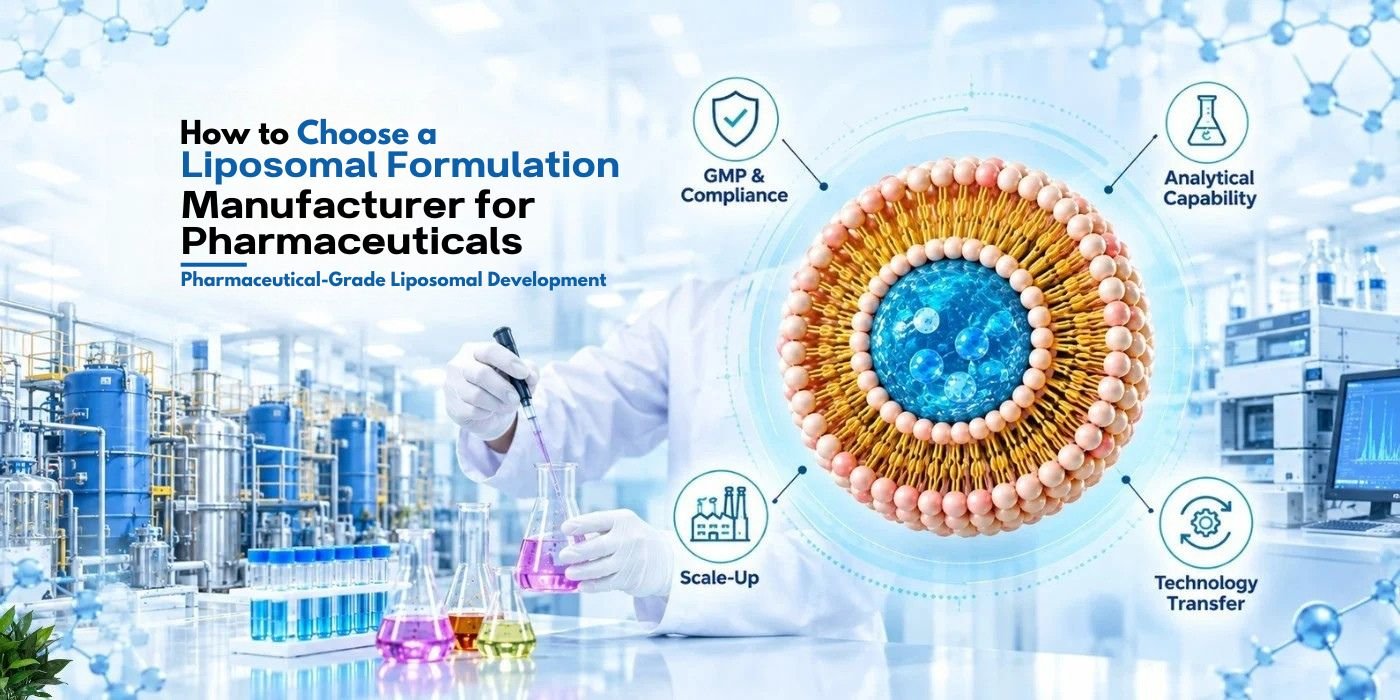
Most pharmaceutical brands approach manufacturer selection as a procurement exercise. With liposomal products, that approach is expensive. FDA and EMA recognise the complexity of liposomal drug products, making GMP scope, analytical capability, and process documentation important considerations during regulatory development and review. Discovering those gaps after development is complete costs far more than a rigorous evaluation upfront.
In this blog, we walk through what that evaluation actually looks like for a liposomal formulation manufacturer operating at pharmaceutical grade.
Key Takeaways:
- GMP certification scope and issuing authority matter more than certificate existence alone.
- Analytical infrastructure determines whether your batch data holds up under regulatory review.
- Technology transfer documentation is what separates a genuine partner from a production-only supplier.
Quick Answer: Choose a liposomal formulation manufacturer by verifying GMP scope, analytical infrastructure, validated scale-up processes, and documented technology transfer capability for pharmaceutical applications.
How to Evaluate GMP Certification Before You Choose a Manufacturer
When evaluating a GMP-certified liposomal pharmaceutical manufacturer, procurement and regulatory teams should review the scope of the manufacturing authorisation, applicable dosage forms, and inspection and compliance history. These factors can help determine whether a site suits a particular product and target market.
Identify Issuing Authority.
India applies GMP requirements under its applicable drug regulations, including the revised Schedule M requirements. WHO-GMP certification may be relevant to international supply and Certificate of Pharmaceutical Product (CoPP/COPP) processes, while manufacturers supplying regulated markets may also need to meet the applicable requirements of authorities such as the European Union or US FDA. These frameworks are not interchangeable; requirements depend on the product, manufacturing activity, destination market, and applicable regulations.
Confirm Manufacturing Scope
Check that the manufacturer’s licences and GMP documentation cover the relevant manufacturing activities, dosage form, facility and, where applicable, sterile manufacturing operations. For a liposomal injectable product, verify authorisation for the applicable sterile manufacturing processes. Supporting documents such as the Site Master File may provide additional information about the facility, but review the certificate and manufacturing licence together.
Verify Certification Independently
Where the relevant regulatory authority provides an official verification or certificate database, use it to confirm the certificate number, issuing authority, scope and validity. Do not rely on a copy supplied by the manufacturer. Procurement teams should use the applicable CDSCO or state regulatory sources and request clarification from the manufacturer where the status or scope of a certificate is unclear.
Determine Certificate of Pharmaceutical Product (CoPP/COPP)
A CoPP is a regulatory document used within the WHO Certification Scheme for the quality of pharmaceutical products and can form part of an importing country’s registration requirements. Confirm the importing authority’s current requirements rather than assuming that every international registration requires a CoPP.
Review available inspection and compliance.
Where permitted by the manufacturer and applicable confidentiality requirements, review the dates of recent regulatory inspections, observations, and the status of corrective and preventive actions (CAPA).
What a Manufacturer’s Analytical Infrastructure Actually Tells You
Analytical infrastructure is a key indicator of a manufacturer’s capabilities and supports reliable characterisation data for regulatory assessment.
- FDA and EMA for liposomal submissions: Relevant characterisation may include morphology, particle size, zeta potential, encapsulation efficiency, drug-to-lipid ratio, in vitro drug release, and phase transition temperature. Drug-to-lipid ratio, in vitro drug release, and phase transition temperature. A COA alone may not provide all the information needed to support the CMC section of an IND or NDA.
- Free and encapsulated drug separation: Total drug concentration alone does not fully characterise drug distribution within a liposomal product. Where relevant, manufacturers should quantify free and encapsulated drug fractions using suitable methods.
- Review particle size distribution and PDI: PDI can help assess the uniformity of a liposomal particle population. Do not assume a universal PDI threshold defines pharmaceutical-grade liposomes.
- Cryo-TEM confirms vesicle formation: DLS confirms size distribution but not morphology. Evaluate liposome morphology and structure using suitable complementary analytical techniques. Cryo-TEM may provide useful structural information when appropriate for the product.
- Analytical method validation: Validation requires documented accuracy, precision, specificity, and linearity. Request validation reports, not just test results.
What to Ask About Scale-Up Process Capability Before Committing
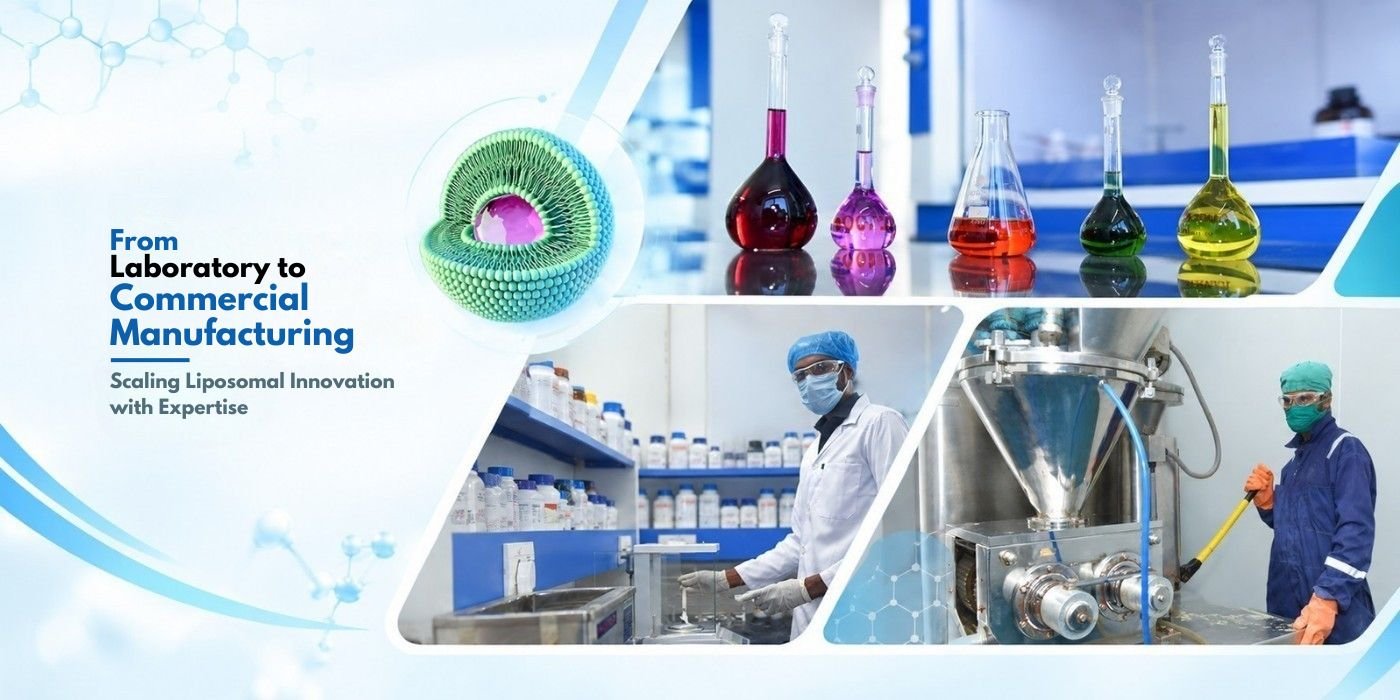
A capable manufacturer should demonstrate controlled scale-up from development batches to pilot and commercial production.
- FDA and EMA liposomal submissions: Relevant characterisation may include morphology, particle size, zeta potential, encapsulation efficiency, drug-to-lipid ratio, release, and phase transition temperature. The appropriate parameters depend on the product and development stage, so a COA alone may not support an IND or NDA.
- Free and encapsulated drug separation: Total drug concentration does not fully characterise drug distribution within a liposomal product. Where relevant, manufacturers should quantify both encapsulated and free drug fractions using suitable analytical methods.
- Review particle size distribution and PDI: PDI can help assess the uniformity of a liposomal particle population. Do not assume that a universal PDI threshold defines pharmaceutical-grade liposomes. Request appropriate DLS data and supporting acceptance criteria for representative production batches.
- Confirm liposome morphology: DLS primarily characterises particle size and size distribution, not morphology. Evaluate morphology and liposome structure using suitable complementary analytical techniques. Cryo-TEM may provide useful structural and morphological information when appropriate for the product.
- Analytical method validation: Validate or qualify analytical methods for their intended purpose. Review evidence covering relevant characteristics such as accuracy, precision, specificity, and linearity, where applicable. Request method-validation documentation alongside representative analytical results.
Technology Transfer Documentation: What a Genuine Partner Provides
Technology transfer involves sharing product, process, analytical, and manufacturing knowledge between development and production teams. A credible transfer helps the receiving site reproduce the process consistently and reliably.
- Written transfer plan: A documented plan should define responsibilities, activities, timelines, quality requirements, risks, and acceptance criteria. Clear planning helps ensure important technical decisions remain traceable throughout the transfer.
- Manufacturing documentation: Relevant manufacturing records should describe processing steps, critical parameters, controls, and product requirements. The documentation package should reflect the product, development stage, manufacturing process, and applicable regulatory expectations.
- Analytical method transfer: Transfer analytical procedures using an appropriate, documented approach. The receiving laboratory should demonstrate that transferred methods perform under its operating conditions.
- Qualification and validation: Qualification and validation activities should reflect the product lifecycle, process complexity, and identified risks. Review available evidence supporting process performance and confirm that acceptance criteria were predefined and appropriately justified.
- Process knowledge and training: Effective transfers should capture both documented information and practical process knowledge. Training should cover critical process parameters, operating procedures, troubleshooting, and manufacturing observations.
India’s Liposomal Manufacturing Landscape as a Procurement Decision
The global liposomal drug delivery market has grown dramatically, with an annual growth rate of 13.2% through 2027 [1]. This growth attracts both pharmaceutical-grade manufacturers and suppliers whose liposomal capability may involve lecithin mixing without adequate vesicle characterisation. The distinction matters in practice; India’s potential cost advantage can come from vertical integration, where raw material sourcing through final liposomal conversion operates within a controlled GMP supply chain. A manufacturer sourcing lipid excipients from suppliers without appropriate quality controls may introduce additional qualification and traceability requirements when manufacturing liposomal products under GMP conditions.
Conclusion
The manufacturers worth shortlisting are the ones who can answer hard questions before you sign. Ask for relevant batch data, facility documentation, applicable regulatory certificates, and a written technology-transfer plan. If key documentation is unavailable, request clarification and assess whether sufficient objective evidence exists to qualify the manufacturer. India’s liposomal manufacturing landscape has expanded significantly, while GMP scope, analytical capability, and transfer documentation remain important supplier-evaluation factors. LipoEdgeTM evaluates precisely, with accurate development built around the standard of evidence.
References
- Wang, Y. and Grainger, D.W. (2022). Regulatory considerations specific to liposome drug development as complex drug products. Frontiers in Drug Delivery, [online] 2. doi:10.3389/fddev.2022.901281.
Review the manufacturer’s GMP status, manufacturing scope, analytical capabilities, technology-transfer process, validation documentation, and relevant regulatory experience.
Technology transfer ensures that critical product and process knowledge moves effectively between development and manufacturing teams. It also supports consistent process execution at the receiving site.
Assess process reproducibility, critical process parameters, equipment suitability, analytical comparability, batch consistency, validation strategy, and the manufacturer’s experience with commercial-scale liposomal manufacturing.
Depending on the product, relevant tests may include particle size, PDI, zeta potential, encapsulation efficiency, morphology, drug-to-lipid ratio, and in vitro release.
Depending on the project, relevant documentation may include GMP certificates, manufacturing licences, analytical reports, validation records, technology-transfer documents, and applicable regulatory certificates.