
Why Brands Should Collaborate with Liposomal Manufacturers?
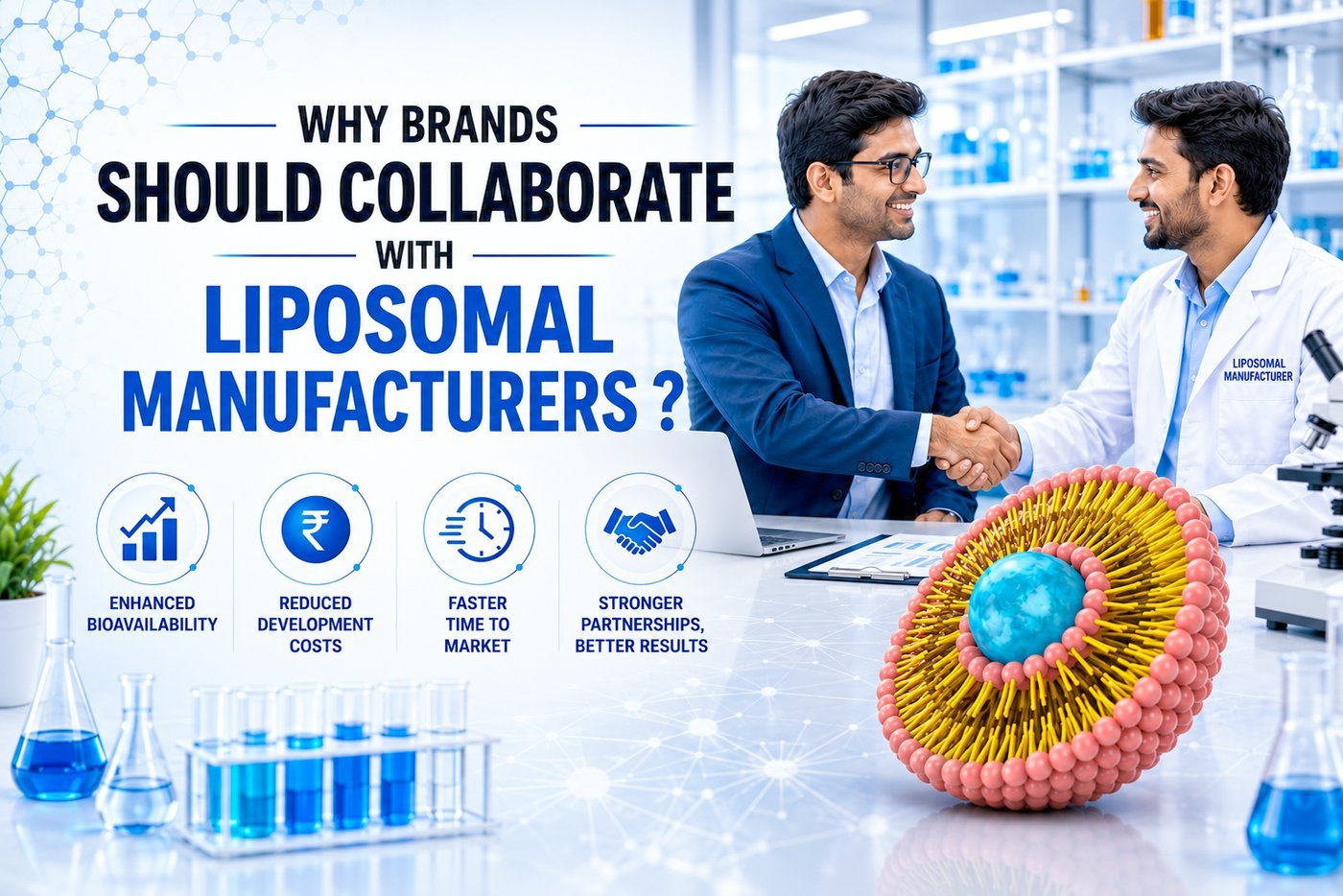
The modern pharmaceutical landscape increasingly demands innovative delivery systems that enhance therapeutic efficacy while reducing manufacturing complexities. Traditional supplement formulations often struggle with bioavailability limitations, creating opportunities for advanced technology partnerships. Liposomal manufacturer collaborations offer unprecedented advantages through enhanced absorption rates, reduced development costs, and accelerated market entry timelines.
These partnerships represent more than operational efficiency gains; they create sustainable competitive advantages through shared expertise and technological innovation.
In this blog, we explore why forward-thinking brands are prioritising strategic partnerships with liposomal manufacturers to drive growth and innovation.
Key Takeaways:
- Enhanced bioavailability through liposomal technology delivers 2-5x better absorption rates than traditional formulations.
- Manufacturing partnerships eliminate costly R&D investments while providing 4-6 week product launch timelines.
- Strategic collaborations unlock premium market positioning by validating innovation and ensuring regulatory compliance.
Quick Answer: Brands should collaborate with liposomal manufacturers because partnerships provide immediate access to proven technology that delivers 2-5x better bioavailability, accelerate market entry by 75%, and offer competitive advantages.
Enhanced Bioavailability Creates Customer Trust
Clinical research consistently demonstrates that liposomal formulations deliver measurable absorption advantages that translate directly into consumer confidence and brand loyalty.
- Superior Absorption: Multiple peer-reviewed studies show that liposomal supplements achieve 2-5x higher bioavailability than traditional formulations, with specific nutrients demonstrating even greater improvements.
- Clinical trial validation: Randomised controlled trials, including NCT06010121, which compares liposomal versus traditional Vitamin D3 formulations, provide the scientific foundation that healthcare practitioners and informed consumers demand when evaluating supplement efficacy.
- Measurable plasma concentration differences: Laboratory analysis reveals liposomal Vitamin C achieves significantly higher blood plasma levels than standard ascorbic acid formulations. Research published in the Journal of Nutritional Science demonstrates that liposomal vitamin C may achieve higher plasma concentrations compared to traditional oral Vitamin C.
- Reduced side effects: Liposomal delivery minimises gastrointestinal irritation, a common side effect of traditional mineral supplements, particularly those containing iron or magnesium. This gentler approach reduces product discontinuation rates and negative reviews.
- Dose efficiency: Enhanced bioavailability allows brands to achieve therapeutic benefits with lower active ingredient quantities. Customers recognise that this efficiency translates to better value, strengthening brand trust and encouraging repeat purchases across product ranges.
Partnership Benefits Over In-House Development
Strategic partnerships with experienced manufacturers provide immediate access to advanced liposomal technology while eliminating the substantial costs and technical risks associated with independent development programmes.
- Established partnerships deliver 4-6 week product launches versus 12-18 months for internal development. Clinical studies show that liposomal vitamin C achieves 55% higher serum concentrations than controls after 2 hours, providing an immediate competitive advantage.
- Brand collaboration removes equipment purchases, facility modifications, and dedicated research teams required for pharmaceutical-grade liposomal production. Partners absorb these substantial infrastructure costs while brands access proven technologies.
- Partnerships provide proprietary encapsulation technologies with proven stability profiles. Clinical trials demonstrate that liposomal formulations achieve 27% higher plasma concentrations and 21% improved bioavailability versus traditional supplements [1].
- Established manufacturers, such as the LipoEdge product line, offer formulations with significantly higher liposomal bioavailability than traditional supplements. Clinical evidence demonstrates 1.77× higher absorption rates while eliminating internal development costs exceeding £1 million annually.
- Experienced partners handle regulatory compliance, quality systems, and scale-up challenges. This eliminates 70% of typical formulation failure risks that affect companies attempting internal liposomal development programmes.
While partnerships offer global opportunities, specific geographic regions demonstrate exceptional manufacturing capabilities and competitive advantages.
India Leads Global Liposomal Manufacturing
India has emerged as a dominant force in global liposomal manufacturing, combining advanced production capabilities with competitive costs and established regulatory compliance frameworks.
1. Regulatory Compliance
Indian manufacturers maintain WHO-GMP certification alongside FDA registration, ensuring products meet stringent global quality requirements. Facilities comply with multiple international standards, including FSSAI, CDSCO, and European pharmacopoeial guidelines simultaneously. The dual compliance approach enables seamless market access across diverse regulatory environments without additional certification barriers.
2. Cost-Effective Production
India offers manufacturing costs 40-60% lower than Western counterparts while maintaining pharmaceutical-grade quality standards. Manufacturing facilities in Kolkata and Dahej demonstrate how Indian infrastructure combines competitive pricing with advanced technology capabilities. These economic benefits allow brands to achieve better profit margins while accessing premium liposomal technology through established partnerships.
Strategic Partnerships
Major international collaborations have positioned Indian manufacturers as preferred global partners for liposomal ingredient supply. Companies like West Bengal Chemical Industries Limited, with their LipoEdge product line, showcase comprehensive CDMO services and regulatory documentation support. These alliances provide technical support, formulation expertise, and reliable supply chains for international brand development.
Innovation Centres Drive Technology
Indian research facilities focus on proprietary encapsulation technologies, particle size optimisation, and stability enhancement for diverse applications. Companies invest heavily in R&D infrastructure to develop novel liposomal formulations for the pharmaceutical and nutraceutical markets. The innovation focus ensures continuous technological advancement while maintaining cost competitiveness in global manufacturing operations.
Manufacturing excellence requires collaborative innovation frameworks that accelerate technological advancement and competitive differentiation.
Technology Collaboration Accelerates Innovation
Strategic collaborations between academic institutions, research centres, and liposomal manufacturer partners drive technological advancement through shared expertise and validated methodologies, resulting in measurable improvements to product development timelines and therapeutic efficacy.
- Academic-industry partnerships demonstrate significant improvements in formulation performance through collaborative optimisation studies. Research collaborations achieve encapsulation efficiencies ranging from 36.17 to 84.61% for anthocyanins through systematic formulation design using Central Composite Design methodologies developed jointly by the institutions [2].
- Joint research initiatives enable precise control over liposomal characteristics through collaborative analytical methods. Collaborative studies demonstrate median particle diameters of approximately 200 nm, with polydispersity indices below 0.300, achieved through shared high-pressure homogenization protocols.
- Collaboration between academic research and manufacturing expertise creates standardised production protocols, ensuring reproducible quality outcomes. Joint development programs establish critical parameters for CMC-Na, lecithin, and water ratios, optimising both stability and manufacturing efficiency.
- Collaborative partnerships provide access to advanced characterisation techniques, including dynamic light scattering, rheological analysis, and electro kinetic measurements. These shared resources reduce individual investment requirements while improving formulation validation through comprehensive analytical protocols.
- Academic-industry collaboration develops systematic evaluation frameworks enabling rapid formulation optimisation through statistical design approaches. Collaborative optimisation using a Central Composite Design yields suitability index values of 0.804 for optimal formulations, leveraging shared expertise in liposomal innovations.
Collaborative innovation delivers present advantages while positioning companies for future market expansion opportunities.
Future Market Growth Through Strategic Partnerships
Partnership-driven growth models between liposomal manufacturer organisations and pharmaceutical enterprises are fundamentally transforming market dynamics through measurable competitive advantages.
- Joint development partnerships demonstrate exceptional expansion rates through collaborative technology advancement programs targeting diverse therapeutic applications. The global liposomal market is projected to grow from USD 6.59 billion in 2025 to USD 15.79 billion by 2034, with brand collaboration initiatives capturing market share through combined liposomal innovations and integrated distribution networks.
- Alliance-based funding models deliver superior returns while reducing individual company risk exposure across comprehensive development cycles. Venture financing for liposomal CDMOs reached $620 million in 2023, up 51% from $410 million in 2021.
- Microfluidic reactor throughput increases of 35% year-over-year enable batch yields of up to 500 mL per cycle through brand collaboration process optimisation initiatives across partner facilities.
- Global alliance structures provide rapid entry into high-growth markets through established regulatory pathways and local liposomal manufacturer capabilities. Local CDMOs invested $180 million in establishing LNP production lines in China, India, and Brazil during 2023, through partnership-enabled market access and localised liposomal innovations.
- Partnership models reduce characterisation assay time from 12 to 6 weeks, enabling faster development cycles through collaborative liposomal innovation platforms.
Final Thoughts
The pharmaceutical industry’s shift toward collaborative innovation models reflects deeper market realities that forward-thinking companies cannot afford to ignore. Smart brands recognise that partnering with an experienced liposomal manufacturer provides immediate access to validated technologies and proven manufacturing expertise. These alliances create sustainable competitive advantages by enhancing product efficacy, reducing time-to-market, and delivering superior consumer outcomes that drive long-term brand loyalty.
The companies that establish these strategic partnerships today position themselves as market leaders in tomorrow’s competitive landscape. LipoEdge demonstrates how comprehensive technology transfer and collaborative development can transform innovative concepts into market-ready products that meet global quality standards.
References
- Purpura, M., Jäger, R., Godavarthi, A., Bhaskarachar, D. and Tinsley, G.M. (2024). Liposomal delivery enhances absorption of vitamin C into plasma and leukocytes: a double-blind, placebo-controlled, randomized trial. European Journal of Nutrition.
- Lapčík L, Lapčíková B, Valenta T, Vašina M, Dudová P, Fišera M. Study of Natural Dyes’ Liposomal Encapsulation in Food Dispersion Model Systems via High-Pressure Homogenization. Molecules. 2025 Apr 20;30(8):1845. doi: 10.3390/molecules30081845. PMID: 40333878; PMCID: PMC12029904.
Frequently Asked Questions
In vitro chemical testing generates release, stability, and bioaccessibility data, enabling informed formulation decisions across nutraceutical, pharmaceutical, and cosmeceutical product development pipelines. This reduces development uncertainty, supports faster optimisation of dosage forms, and strengthens technical confidence before scale-up, validation, and regulatory submission stages.
The INFOGEST model simulates human digestion conditions across salivary, gastric, and intestinal phases, enabling realistic evaluation of liposomal stability and release behaviour. It helps predict oral bioavailability, validate formulation performance under physiological conditions, and support scientifically substantiated claims for product positioning and regulatory documentation.
Dialysis and simulated digestion studies quantify controlled release behaviour, enabling clear differentiation between liposomal systems and conventional formulations in performance-driven markets. This supports claims of sustained delivery, improved absorption, and enhanced functionality, strengthening product positioning across competitive nutraceutical and pharmaceutical segments globally.
LipoEdge provides integrated in vitro testing using validated digestion models, diffusion systems, and antioxidant assays to ensure reliable and reproducible analytical outcomes. It enables clients to generate regulatory-aligned data, optimise formulations effectively, and accelerate product development timelines with strong technical and commercial confidence.
LipoEdge combines formulation understanding with analytical expertise, enabling customised study designs tailored to liposomal, nanosomal, and encapsulated delivery systems across applications. This ensures deeper insight into product behaviour, improved interpretation of results, and stronger alignment between laboratory findings and real-world product performance expectations.
Clinical studies consistently demonstrate that liposomal formulations achieve 2-5x higher absorption than traditional supplement delivery systems. Research shows that liposomal vitamin C reaches serum concentrations 55% higher than those of standard ascorbic acid formulations within 2 hours.
Indian manufacturers offer WHO-GMP certification alongside FDA registration, ensuring products meet stringent global quality requirements. These facilities comply with FSSAI, CDSCO, and European pharmacopeial guidelines, enabling seamless market access across diverse regulatory environments.
Established partnerships deliver a 4-6 week turnaround for standard formulations, while custom developments typically take 8-12 weeks. Independent development cycles average 12-18 months from concept through commercial production, making partnerships 75% faster for market entry.
Partnerships eliminate the £2-5 million capital investment required for pharmaceutical-grade equipment, specialised facilities, and dedicated research teams. Companies avoid 12-18 month internal development timelines while accessing proven formulations with 4-6 week product launch capabilities.
Manufacturers provide white-label formulations, custom development partnerships, technology licensing, joint R&D initiatives, and complete turnkey solutions. These models range from standard formulation access to comprehensive development programs, including regulatory submission and technology transfer.